Douglas Engelbart is best known for the computer mouse, and that is a little like remembering the Wright brothers for the propeller. He thought of the mouse as a minor part of a much larger idea. He believed that computers could help people think together, solve problems faster and deal with the growing complexity of the world. He called the goal "augmenting human intellect." He spent his career trying to make it real.
A radar technician reads an essay
Engelbart was born on January 30, 1925, in Portland, Oregon, and grew up in the Pacific Northwest. He studied electrical engineering at Oregon State College, and his studies were interrupted when he joined the United States Navy near the end of the Second World War. The Navy trained him as a radar technician and sent him to the Philippines.
While he waited there for transport home, Engelbart picked up a copy of an essay in a library hut run by the Red Cross. The essay was "As We May Think," written by Vannevar Bush and published in 1945. Bush, who had directed American scientific research during the war, imagined a desk-sized device called the Memex. It would store a person's books, records and notes, and let the person link them together along trails of association. The vision was not about calculation. It was about the way knowledge is organized and shared.
The essay stayed with Engelbart. Radar had taught him that information could appear on a screen and respond to an operator. He began to wonder why a computer could not do the same for ideas.
A plan for a life's work
After the war Engelbart finished his degree in 1948 and worked for a time as an engineer at the Ames laboratory of the National Advisory Committee for Aeronautics, the predecessor to NASA. He then went to the University of California, Berkeley, where he earned a doctorate in electrical engineering in 1955. He worked on early computers there and developed several patents on digital circuits.
By then he had decided what to do with his life. He wanted to find ways to increase the collective ability of people to tackle hard problems. Many friends thought the goal vague. Engelbart responded by thinking about it carefully. In 1957 he joined the Stanford Research Institute, a research organization in Menlo Park, California, where he could work on the idea.
The conceptual framework
In 1962 Engelbart published a report titled "Augmenting Human Intellect: A Conceptual Framework." It set out his philosophy in detail. He did not mean artificial intelligence, in which machines think on their own. He meant better tools for human minds.
He argued that a person's capability depends on a whole system. The system has four parts: the tools a person uses, the language in which the person thinks, the methods the person follows and the training the person has received. He used a long label for this combination, and he insisted that improving only one part would not be enough. A better tool, such as a computer, would work well only if people also changed their methods and learned new skills.
He also had a view of progress that he later called bootstrapping. A group that works on improving its own tools becomes better at improving them, and the improvement compounds. The group that builds the tools should be the first to use them. This is the logic of the Augmentation Research Center, which he founded at the Stanford Research Institute in the early 1960s.
Funding and a team
Engelbart's ideas were unusual, and funding was hard to find. The breakthrough came from the federal government. J. C. R. Licklider, who ran computing research at the Advanced Research Projects Agency, shared a similar vision of "man-computer symbiosis." Licklider's successors, including Robert Taylor, continued to support the work. NASA and the Air Force also provided money.
With this support, Engelbart gathered a team of engineers and programmers. Bill English, an engineer, was one of the most important. Others built software, designed hardware and tested the results by using the system every day. The group wrote its own documents and managed its own projects with the tools it was building. This habit of using the tools to build the tools was part of the bootstrapping idea.
The mouse
One of the problems the team faced was pointing. If a computer shows text on a screen, how does a person select a word or a part of a drawing? Researchers tried many devices, including the light pen, a joystick, a graphics tablet and a knee-operated lever. Engelbart's group tested these in experiments, timing how quickly and accurately people could choose targets.
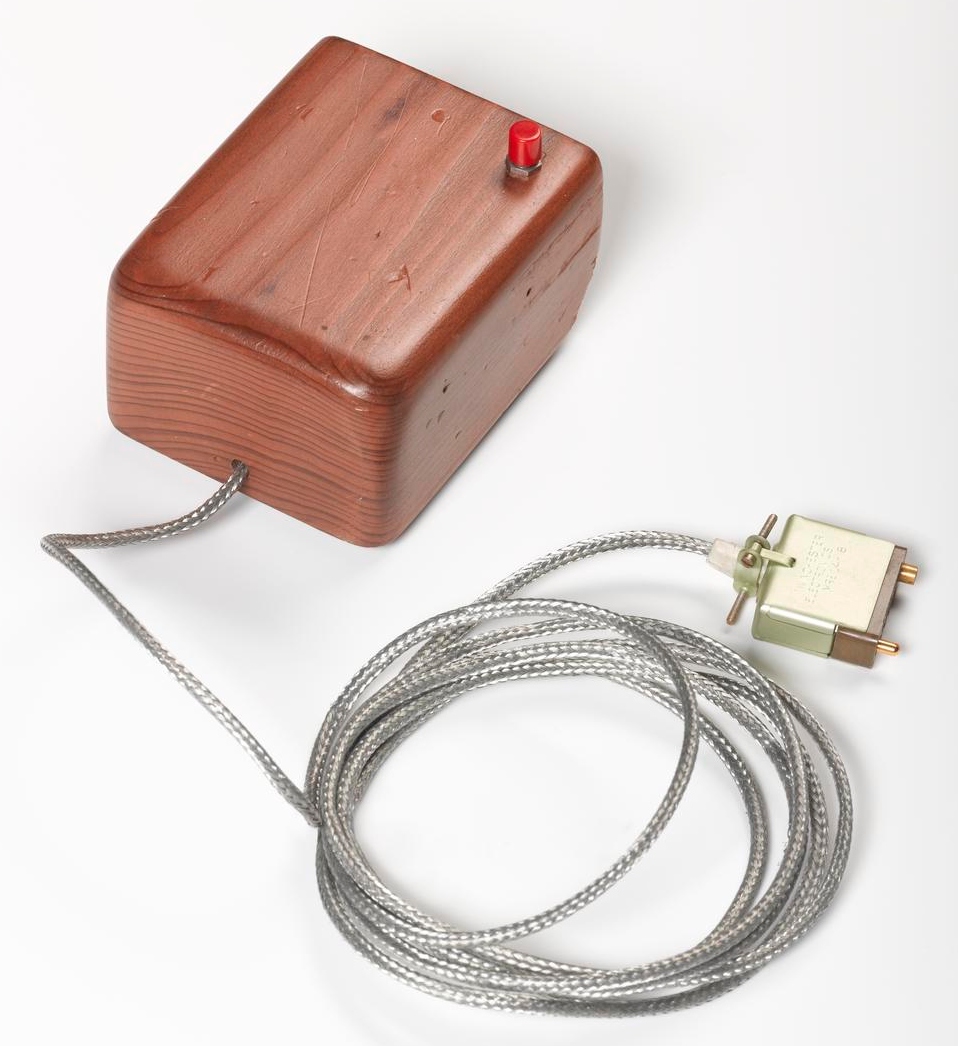
A device that Engelbart had sketched in 1961, a small wheeled box that could be rolled on a desk, performed well in the tests. In 1964 Bill English built the first working prototype. It was a small wooden shell holding two wheels, set at right angles to each other, with a single button on top and a cord at the back. One wheel recorded motion left and right, and the other recorded motion forward and back. The official name was the X-Y Position Indicator for a Display System. People in the lab began to call it the mouse because the cord looked like a tail, and the nickname stuck.
Engelbart filed a patent application in 1967. The United States granted Patent 3,541,541 in 1970. The patent belonged to the Stanford Research Institute, and the institute later licensed the technology to others. Engelbart did not receive royalties from the mouse. The patent expired in the 1980s, before personal computers made the device common.
The chorded keyset and the system
The mouse was only one input device. Engelbart also developed a keyset for the left hand with five keys, which could be pressed in combinations called chords to type letters and commands. A user could point with the right hand, enter text and commands with the left, and keep eyes on the screen. The keyset never became popular, since most people wanted to keep using the regular keyboard, but it showed how seriously the group considered the whole interaction.
The software ran on a system called NLS, short for oN-Line System. It supported many tasks that now seem normal. Users could edit text on a screen, restructure an outline by moving whole sections, and link one document to another. A document could be viewed in different ways, such as only the headings. Several people at different terminals could work on the same document, and they could see each other's work.
The Mother of All Demos
On December 9, 1968, Engelbart gave a public demonstration at the Fall Joint Computer Conference in San Francisco. The presentation lasted about 90 minutes. Engelbart sat on stage in front of a large display, wearing a headset, with a mouse in his right hand and a keyset in his left. A team in Menlo Park, about thirty miles away, connected by microwave links and leased telephone lines, sent video and data to the screen.
During the session he showed the audience a series of capabilities. He edited text and rearranged a list. He created links between pieces of information, an early form of hypertext. He worked in several windows, and he showed a collaborator at a distance working on the same document, while the two appeared on screen in video. He used the mouse to select and move items.
Few people had seen anything like it. Many in the audience were used to computers that took cards and printed results hours later. Engelbart showed a machine that responded at once and helped him think. The audience gave him a standing ovation. Later writers called the event "the mother of all demos", a name that has stayed with it.
The effect of the demonstration was slow but deep. Several people who saw it, or heard about it, went on to build the first personal computers and the networks that linked them. Engelbart's center was also one of the first two nodes of the ARPANET, the early computer network, in 1969. It served as a place where network users could look up information.
Ideas that stayed behind
Not every part of Engelbart's vision reached the public. He cared about structure in documents, so that a reader could expand and collapse an outline and jump between linked passages. He cared about teams that could share a screen and talk while they worked. He cared about methods that a group would teach itself to use well. Commercial products took the pointing device and the window, which were easy to sell, and left much of the rest. Writers on the history of computing often say that parts of his program are still unfinished, and that his questions are still worth asking.
Difficult years
The success of the demonstration did not bring lasting security. In the early 1970s the center lost funding as government priorities shifted. Some of his best staff left, and a number went to the new Xerox Palo Alto Research Center, where they helped to build the Alto. Engelbart was disappointed, and he felt that many people had taken pieces of his system without understanding the whole vision.
In 1977 the Stanford Research Institute transferred his group to a company called Tymshare, which wanted to sell the technology commercially. The company was later acquired by McDonnell Douglas. Engelbart found the business setting a poor fit for his ambitions. In practice, many commercial products picked up the features that were easy to sell, like text editing, but not the larger vision of group intelligence.
Later work and recognition
In 1989 Engelbart and his daughter, Christina Engelbart, founded an organization they called the Bootstrap Institute, later renamed the Doug Engelbart Institute. Its mission was to continue his work on raising the effectiveness of groups that tackle large, urgent problems. Engelbart spoke often about the need for what he called collective IQ.
Honors arrived during the final decades of his life. He received the Lemelson-MIT Prize in 1997, and in the same year the Association for Computing Machinery gave him the Turing Award, often called the Nobel Prize of computing. In 2000 President Bill Clinton awarded him the National Medal of Technology. Engelbart died on July 2, 2013, at his home in Atherton, California, at the age of 88.
What museums can show
The mouse is the object most visitors recognize, and it makes a good starting point. A museum can place a replica of the first mouse next to a modern one and ask visitors what has changed and what has not. The wooden shell and the single button show how simple the first idea was. The modern device, with its optical sensor and scroll wheel, shows how much it has been refined.
A second layer lies behind the object. Visitors can watch excerpts of the 1968 demonstration and compare what they see to the tools they use today. They may be surprised to find that video calls, shared documents, links between pages and windows on a screen were all on display in 1968. That comparison makes a strong case for the value of long-term research.
A third layer concerns the question that Engelbart himself kept asking. Do our tools help us think better, together? Visitors can discuss how a phone, a search engine or a shared document changes what a group can do, and where it falls short.
Questions for reflection
- Engelbart said that tools, methods and training must improve together. Can you think of a technology that failed because only one of these changed?
- Why might the 1968 demonstration have taken so long to change everyday life?
- Which part of your own work or study would you most like to augment, and how?
References and Further Reading
- Engelbart, Douglas C. Augmenting Human Intellect: A Conceptual Framework. Stanford Research Institute, Summary Report AFOSR-3223, 1962.
- Bardini, Thierry. Bootstrapping: Douglas Engelbart, Coevolution, and the Origins of Personal Computing. Stanford University Press, 2000.
- Bush, Vannevar. "As We May Think." The Atlantic Monthly, July 1945.
- Engelbart, Douglas C. "X-Y Position Indicator for a Display System." U.S. Patent 3,541,541, granted November 17, 1970.
- Doug Engelbart Institute. Archive of the 1968 demonstration, "A Research Center for Augmenting Human Intellect."