Welcome to the Mimms Museum's immersive audio guide. This tour, titled Pixels and Polygons, will take you on a 15-minute journey through the history of visual computing. We will explore ten landmark artifacts that represent the "greatest hits" of computer graphics evolution—from the first real-time CRT displays of the 1950s to the birth of the modern GPU at the turn of the millennium.
Stop 1: The Whirlwind Computer (1951)
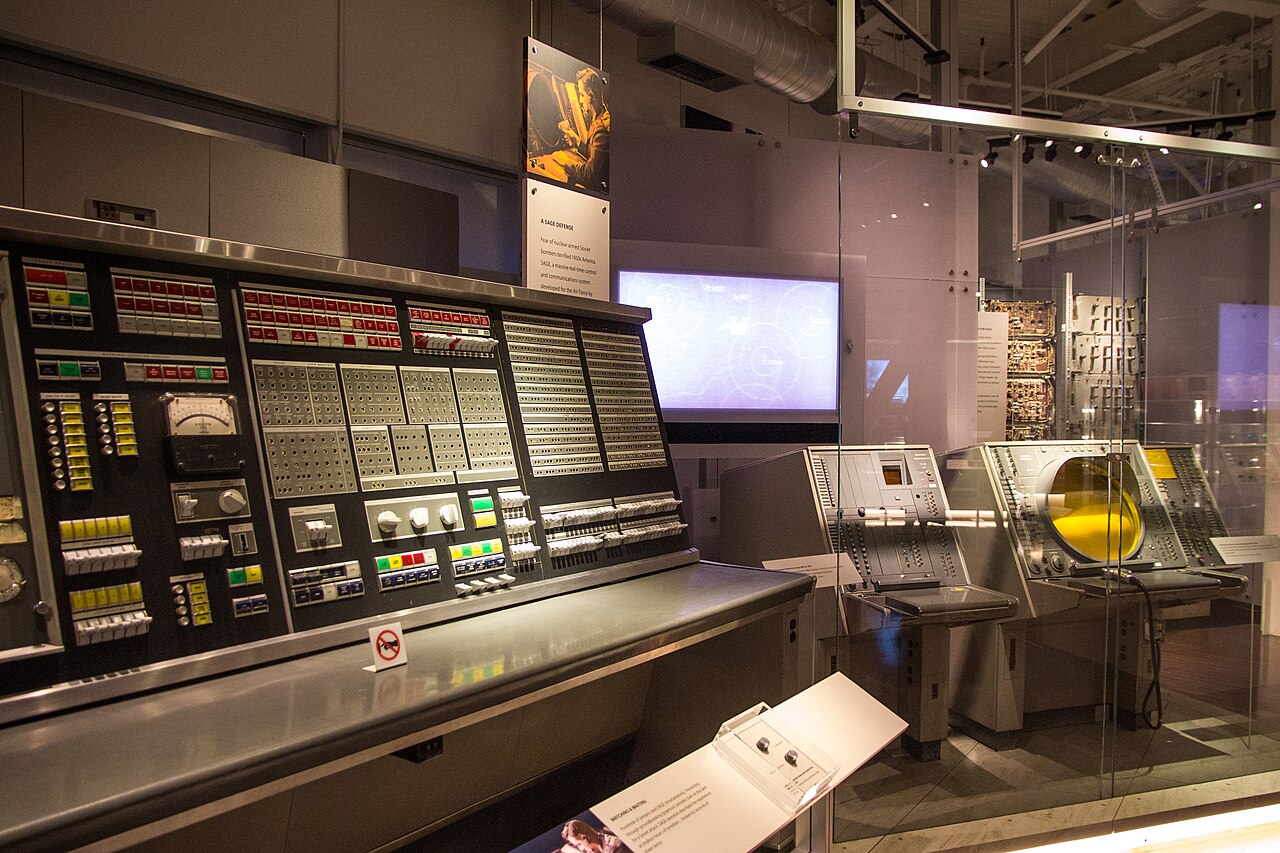
Locate the large, circular monitor console in the Cold War Computing gallery, near the vacuum tube displays.
[Sound: A low, rhythmic humming of massive cooling fans and the rhythmic clicking of relays.] [Music: A mid-century orchestral theme, pulsing with scientific optimism and a hint of Cold War urgency.]You are standing before a fragment of the MIT Whirlwind. In 1951, most people thought of computers as giant calculators—machines that swallowed punch cards and spat out rows of numbers on paper. But the engineers at MIT had a different vision. They wanted a computer that could react to the world in real-time.
Look at that circular screen. It looks like a radar scope, doesn't it? That’s because it essentially was. This was the first digital computer to feature a real-time CRT—a Cathode Ray Tube—display. Before this, "output" meant waiting hours for a printout. With Whirlwind, for the first time, a human could see what the computer was thinking as it was thinking it.
Notice the handheld device sitting on the console. It looks like a flashlight or a heavy pen. That is a Light Gun. If you were a radar operator in the mid-fifties, you would point that gun directly at a "blip" on this screen. When the electron beam passed under your gun, a phototube inside would detect the flash, send a signal back to the computer, and the computer would say, "Aha! You’re talking about this aircraft."
This was the "Big Bang" of interactivity. By combining a visual display with a pointing device, Whirlwind gave us the fundamental DNA of every smartphone, tablet, and PC you’ve ever used. It proved that a computer wasn't just a box of math; it was a space where humans and machines could have a conversation.
[Sound: The hum of the Whirlwind fades into a lighter, electronic chirping.]Stop 2: Sketchpad and the TX-2 (1963)
Move to the next alcove, where you'll see a black-and-white film playing on a 9-inch monitor next to a large transistorized console.
Fast forward a decade to 1963. You’re looking at a film of a young PhD student named Ivan Sutherland. He’s sitting at the Lincoln TX-2, a massive machine for its time, but he’s doing something that looks impossibly modern. He’s drawing.
Sutherland's program, called Sketchpad, was the first true Graphical User Interface. Using a light pen, he could draw lines, circles, and complex shapes. But Sketchpad wasn't just a digital etch-a-sketch. It was "smart." Sutherland introduced Constraints. If he drew a crooked square, he could tell the computer: "Make these lines parallel," and the computer would snap them into perfect alignment.
If you look closely at the film, you might see the word "INK" appearing on the screen. Sutherland would tap that word with his pen to "dip" it in digital ink before drawing. This wasn't just a gimmick; it was the birth of Object-Oriented Programming. He created "master" drawings and "instances." If he changed the master, every copy of that object on the screen updated instantly. In 1963, this was pure science fiction. Sutherland didn't just invent a tool; he invented the entire field of Computer-Aided Design, or CAD.
[Pause 3 seconds]Stop 3: The Tektronix 4014 (1974)
Look for the "Green Screen" terminal with a massive 19-inch vertical monitor and two thumbwheels on the keyboard.
[Sound: A high-pitched, satisfying electronic "chirp" followed by a sudden, bright green flash.]Did you see that flash? That was the sound and sight of an era. This is the Tektronix 4014. In the early 70s, graphics were still too expensive for most businesses because the memory required to "refresh" a screen was astronomically high. Tektronix solved this with the Storage Tube.
Unlike your phone, which redraws the image 60 times a second, this screen "stored" the image directly on the phosphor surface. Once a line was drawn, it stayed there, glowing in that iconic "Tektronix green," until you cleared the whole screen with that blinding flash. It couldn't do animation, and you couldn't erase just one line—it was all or nothing.
But here's why it matters: It was sharp. At a time when other computers were blocky and pixelated, the 4014 could draw smooth, hair-thin lines at a resolution that wouldn't be matched for twenty years. It democratized graphics, bringing high-end engineering and architectural tools to thousands of firms that could finally afford to leave the drafting table behind.
Stop 4: The Utah Teapot (1975)
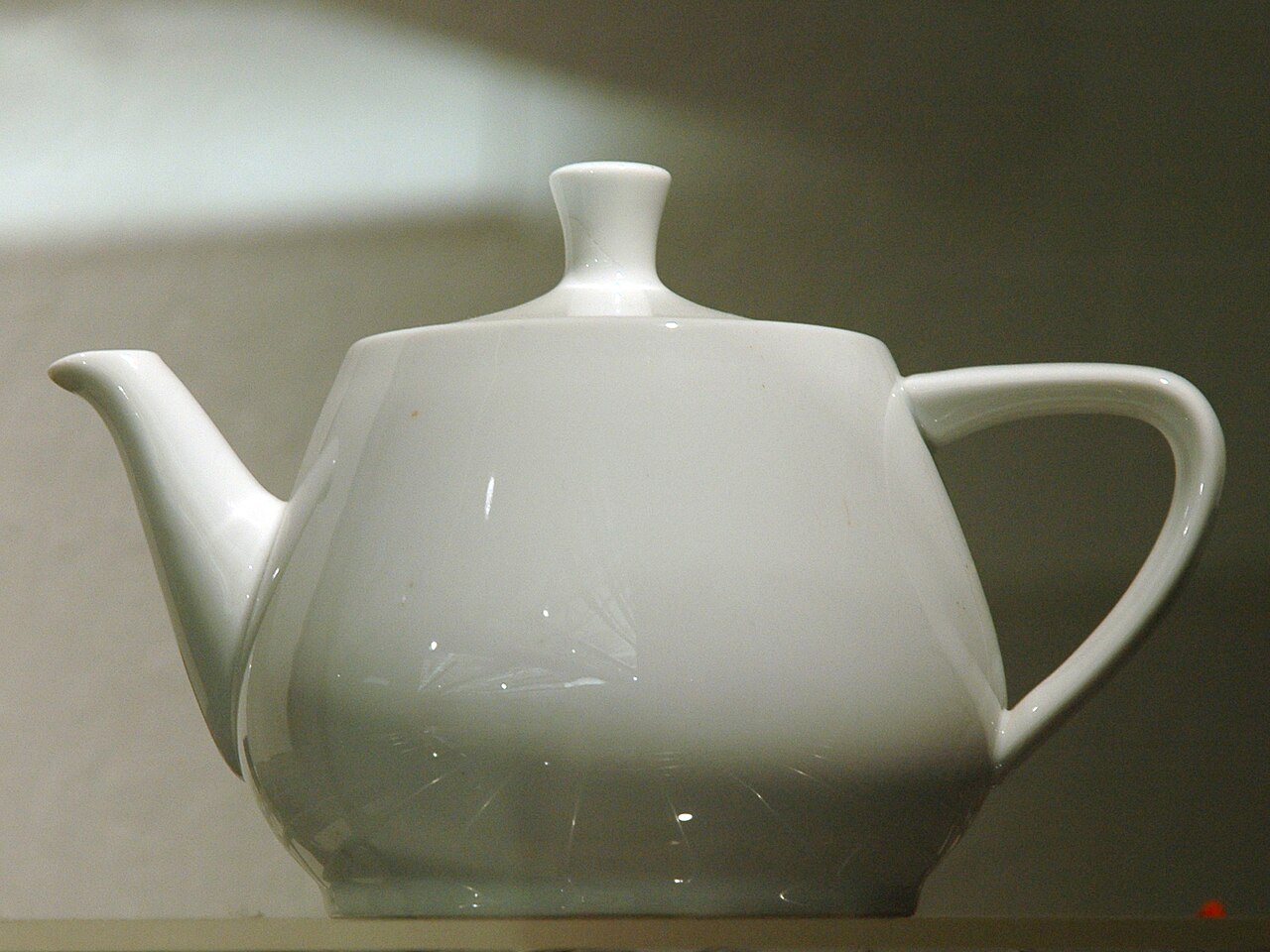
Find the small display case containing a simple, white ceramic Melitta teapot, sitting next to a computer screen showing its digital twin.
You might be wondering why a kitchen appliance is in a computer museum. This is the Utah Teapot, arguably the most famous object in the history of 3D rendering. In 1975, a researcher named Martin Newell needed a complex object to test his math. His wife, Sandra, suggested their Melitta teapot.
Newell sketched the teapot on graph paper and turned those curves into math using Bézier curves. It was perfect: it had a handle with a hole, it cast shadows on itself, and it had complex, smooth surfaces. It became the "Hello, World!" of 3D. If you wrote a new rendering program, the first thing you did was try to make the teapot look real.
A little museum secret: if you look at the digital version on the screen next to it, you’ll notice it looks a bit "squashed" compared to the physical one. That’s because a fellow researcher named Jim Blinn once scaled it by 0.75 just to see how it looked... and the community liked the stouter version so much, it became the global standard. Today, you can find the Utah Teapot hidden as an "Easter Egg" in everything from Toy Story to the Simpson's 3D episodes.
Stop 5: The Xerox Alto (1973/1981)
Locate the upright cabinet with the portrait-oriented monitor and the three-button mouse.
If Whirlwind was the Big Bang, the Xerox Alto was the "Dawn of Man." Developed at Xerox PARC in the 1970s, this machine is the ancestor of nearly everything you see on your desk today. Most importantly, it featured a Bitmapped Display.
Before the Alto, screens were "character-based"—you could only show fixed letters and numbers. On the Alto, every single pixel was a dot of data that could be turned on or off. This allowed for WYSIWYG—"What You See Is What You Get." If you typed a bold word, it actually looked bold on the screen. It gave us windows, icons, menus, and that three-button mouse you see there. It was the future, arrived a decade early.
Stop 6: Silicon Graphics IRIS 1000 (1983)
Look for the sleek, dark workstation with the "SGI" logo, often surrounded by images of early 3D flight simulators.
[Music: Transitions to a sleek, synth-driven 80s tech beat.]In the early 80s, if you wanted 3D graphics, your computer’s brain—the CPU—had to do all the heavy lifting. It was slow. Painfully slow. Then came Silicon Graphics, or SGI. Their secret weapon was the Geometry Engine.
This was a custom-designed chip that did one thing: math for 3D graphics. It offloaded the rotation, scaling, and clipping of 3D objects from the CPU to dedicated hardware. Suddenly, 3D wasn't a series of still images; it was moving. SGI became the backbone of Hollywood, powering the special effects for Jurassic Park and Terminator 2. They also created a software language called IRIS GL, which eventually became OpenGL—the standard language for 3D graphics used by millions of developers today.
Stop 7: The Amiga 1000 (1985)
Find the beige desktop computer with the red "Boing Ball" demo bouncing on the screen.
[Sound: The playful, rhythmic "thump" of the Amiga Boing Ball demo.]While SGI was conquering Hollywood for fifty thousand dollars a pop, the Amiga 1000 was bringing that magic to your living room for twelve hundred. The Amiga was the first true "Multimedia" computer. It didn't just have one processor; it had a team of "custom chips"—named Denise, Paula, and Agnus—that handled graphics and sound independently.
Its greatest trick was HAM mode, or Hold-And-Modify. In 1985, most PCs could only show 16 colors. The Amiga, through some brilliant mathematical shortcuts, could show all 4,096 colors of its palette at once. It allowed for photorealistic images that looked like they belonged on a television screen, not a computer. For a brief, shining moment, the Amiga was the most advanced visual machine on the planet.
Stop 8: The Pixar Image Computer (1986)
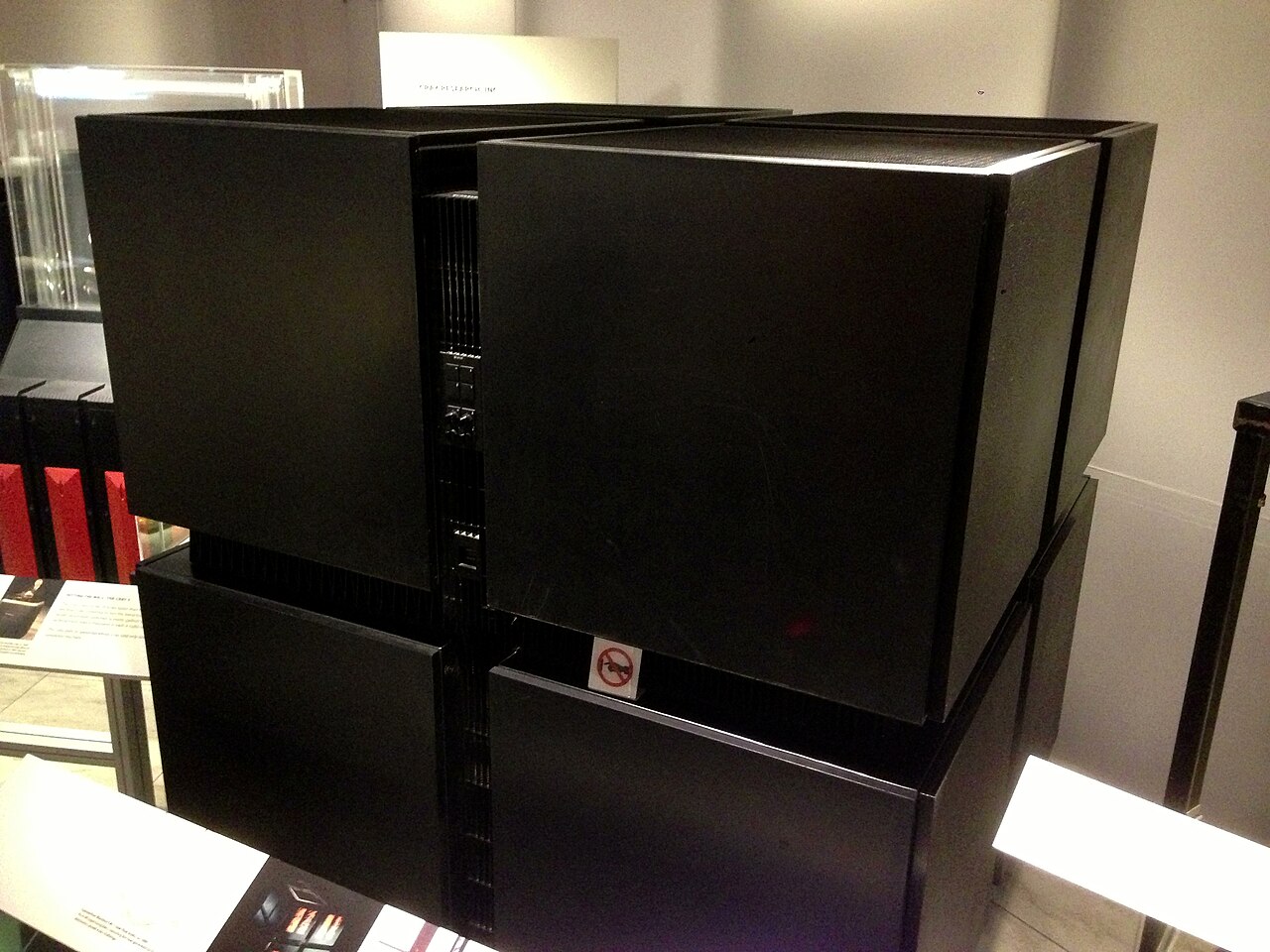
Look for the massive, cube-like workstation with the distinct red and black Pixar logo—yes, that Pixar.
Before they were a movie studio, Pixar was a hardware company. This massive machine, the Pixar Image Computer, was designed to process incredibly high-resolution images for the film industry. It was essentially a supercomputer for pixels. It was so powerful it could handle "Volumetric Rendering"—building 3D models from slices of data.
Interestingly, because it was so expensive—over a hundred thousand dollars—it didn't sell well to filmmakers. Its biggest customers were actually doctors. The Pixar Image Computer was the first machine that could take a stack of 2D CAT scans and turn them into a 3D human body that a surgeon could rotate and "cut" through digitally. Pixar didn't just change animation; they changed medicine.
Stop 9: The 3dfx Voodoo 1 (1996)
Find the glass case with a green circuit board connected to a standard PC by a short, thick "pass-through" cable.
[Sound: A distinctive, metallic mechanical "click" followed by the sound of a roaring wind or rushing water.]If you were a gamer in 1996, that "click" was the sound of your life changing. This is the 3dfx Voodoo 1. It wasn't a full video card; it was an "accelerator." Your normal card handled your desktop, but when you started a 3D game like Quake, this card would physically click on and take over.
Before the Voodoo, 3D games were blocky, pixelated, and jittery. The Voodoo introduced Bilinear Filtering, which smoothed out those pixels into cinematic textures. It brought the power of those $50,000 SGI workstations into a $300 card you could plug into your home PC. It triggered an arms race that defined the next decade of gaming.
Stop 10: The NVIDIA GeForce 256 (1999)
Finish your tour at the display featuring a small, fan-cooled graphics card under a spotlight labeled "The World's First GPU."
[Music: A triumphant, fast-paced electronic finale.]We end our journey here, with the NVIDIA GeForce 256. In 1999, NVIDIA coined a new term for this chip: the GPU, or Graphics Processing Unit. Before this, the computer's CPU still had to calculate where the "vertices"—the corners of the 3D triangles—were located. The GeForce 256 moved that entire process, called "Transform and Lighting," onto the graphics card itself.
This shift was monumental. It freed up the CPU and allowed for games with millions of polygons instead of thousands. But more importantly, it set the stage for the world we live in today. Those same mathematical engines that were built to draw monsters and spaceships are now the engines powering Artificial Intelligence, weather simulation, and cryptocurrency. The GPU is the most powerful tool for calculation ever created, and it all started with the simple desire to make computer games look a little more real.
Thank you for joining us on this tour of Pixels and Polygons. We hope you enjoy the rest of your visit to the Mimms Museum.
[Music: Fades out slowly with a final, digital flourish.]Curator's Citations & References
- Sutherland, I. E. (1963). Sketchpad: A Man-Machine Graphical Communication System. MIT Lincoln Laboratory.
- Newell, M. E. (1975). The Utilization of Procedure Models in Digital Image Synthesis. University of Utah.
- Everett, R. R. (1952). The Whirlwind I Computer. Joint AIEE-IRE Computer Conference.
- Peddie, J. (2013). The History of Visual Magic in Computers. Springer Science & Business Media.
- Reimer, J. (2005). A History of the Amiga, Part 1: Genesis. Ars Technica.
- NVIDIA Corporation (1999). NVIDIA Launches the World's First GPU - GeForce 256. Press Release.