How to use this script: A guide can read it aloud at an Odyssey display, or a recording can play on a device. Cues in brackets are for the person producing the audio. Keep the pace slow, and pause where the script says to.
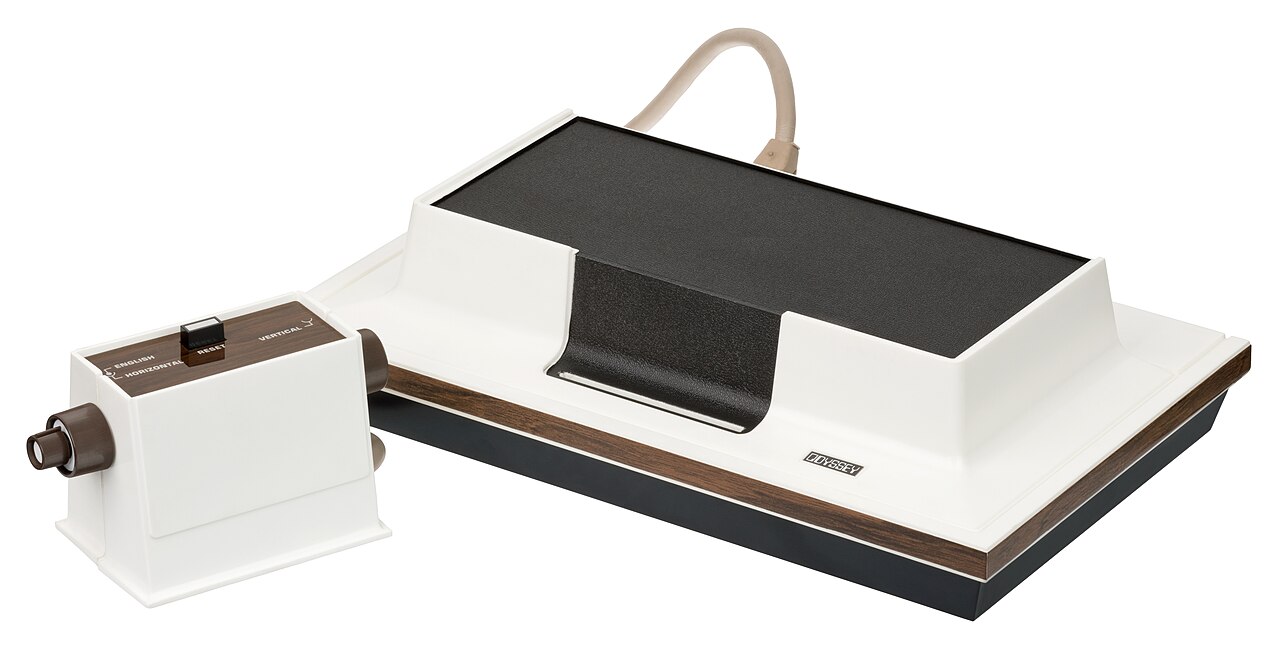
Welcome to the Living Room Revolution. Look at the machine in front of you. It is a beige and woodgrain box with a few dials and two chunky controllers. It looks more like a piece of stereo equipment than like a game console. That is the first surprise. The device you are looking at was the first video game console ever sold to the public.
[Sound of a mechanical switch clicking.]It was called the Magnavox Odyssey, and it went on sale in 1972. Picture a rainy evening that year. A family has a new color television, and they have just brought home this box. It cost about one hundred dollars. That is roughly seven hundred dollars in today's money, so it was not a casual purchase.
They plug it into the back of the television. They switch on the box. And something happens that nobody in the living room has ever seen. A small white square appears on the screen, and they can make it move.
[A soft electronic blip.]Until then, a television was a one-way window. The broadcasters decided what you saw, and all you could do was change the channel. The Odyssey turned the screen into something you could play with. For the first time, the people on the sofa could talk back to the television.
The man with the idea
[Pause for two seconds. The music shifts to a quieter, thoughtful tone.]The idea came from a man named Ralph Baer. He was born in Germany in 1922, into a Jewish family. When he was a teenager, in 1938, his family fled the Nazis and made their way to the United States. Baer settled in New York and found work in electronics. He later served in the United States Army during the Second World War, in military intelligence.
After the war he became an engineer. By the 1960s he was working for a defense electronics company called Sanders Associates, in New Hampshire. He had a day job making military equipment. But he also had an idea that he had first written down in the 1950s. Millions of homes already owned a television set. Why not let people do something with it?
In 1966, Baer sketched out the idea at a bus station, waiting for someone. He wrote a short paper describing a game system that would plug into a television. Sanders let him work on it with a small budget and two colleagues. They built one prototype after another.
The Brown Box
[The sound of a wooden box being set down.]The best known of those prototypes is called the Brown Box. It got its name from the strips of brown woodgrain tape that Baer wrapped around its case to make it look more like a piece of furniture. It could play several games, including table tennis and a shooting game with a toy rifle. A version of this prototype survives in the collection of the Smithsonian's National Museum of American History.
Baer showed the Brown Box to television makers. Several said no. Then Magnavox, a company that made televisions and stereos, agreed to turn it into a product. The result was the console in front of you.
What is inside
[A pause. The synthesizer returns, gently.]Here is a fact that surprises most people. This machine has no computer inside it. No processor. No memory. No software in the way we think of software today.
Inside the box are about forty transistors and a similar number of diodes. These are simple electronic parts that switch current on and off. They are wired together to produce a few white spots on the screen, and a set of controls that move them. That is all.
So how did it play different games? The answer is a clever trick. The console came with a set of plug-in cards. These were small circuit boards, and they were not memory chips. Each card contained wire connections that changed how the circuits inside the console linked to one another. When you plugged in a card, you changed the wiring of the machine. One card made the dots behave like a tennis ball and rackets. Another made them behave like a hunter and a prey.
In a sense, the cards were the first game cartridges. They were not storing a program, but they changed the way the machine behaved, and that idea of swapping the game while keeping the console was new.
The controllers
[A faint click of a dial turning.]Look at the two controllers. They are rectangular boxes that connect to the console by cables. They have no joysticks. Each one has dials: one for moving the spot left and right, one for moving it up and down, and a third dial that Magnavox called English. Turning that one added a spin to the ball, as a tennis player would with a stroke. A button on the controller reset the game.
Playing took coordination. You had to turn two dials at once to move the spot diagonally. Players learned to hold the controller in one hand and turn the dials with the other. It was fiddly, and it was also fun.
Plastic sheets and imagination
[Crinkling plastic.]Now look at the thin colored sheets near the console. These are overlays. The Odyssey could draw only a few simple white shapes on a black screen. It could not draw a tennis court, a football field or a haunted house. So Magnavox supplied transparent plastic sheets printed with those scenes. You placed a sheet over the television screen, where it clung with static electricity. The spots moved behind the plastic, and the picture was complete.
Because of this, the Odyssey was a bit like a board game that happened to include a television. Some games used paper money, dice and cards along with the screen. A game of football, for example, used a game board and a score sheet. The players kept score themselves, since the machine did not count.
The console also had no sound. You played in silence, apart from the voices of the people in the room. Perhaps that made the game more of a social event. Friends and families sat together, argued about the rules and kept their own scores.
The games
[Light music, with a rhythmic blip every few seconds.]The console came with a dozen cards and a collection of games. Table tennis was the simplest. Two players each controlled a white paddle, and a third spot, the ball, was controlled by the machine's circuits. Tennis, hockey and volleyball were variations on the same idea, with different overlays.
Others were more unusual. In a game called Haunted House, one player moved around a plastic map of a mansion, trying to find hidden objects, while the other played the ghost. A game called Roulette used the screen to spin a ball and a pile of play chips. There was even a separate toy rifle, which players could point at the television to shoot at a moving target. The rifle worked by sensing the light of the target spot, a trick that later light guns would use again.
Look for the game box if one is on display. The rules, the score sheets and the play money give a good sense of how different this kind of play was. It was part electronics, part board game, and entirely a social activity.
Setting it up
[The sound of a cable being plugged in.]Setting up an Odyssey took a little patience. The console ran on batteries, or on an optional power adapter. It connected to the television through a switch box on the antenna terminals. The owner chose a channel, usually channel three or four, and tuned it until the picture settled. After that, the owner chose a card, pushed it into the slot on the front, picked an overlay and began to play.
If you have grown up with video games that start with a tap on a screen, this may sound like a long ritual. But it was part of the experience. The family gathered round, the overlay went on the screen, and the game was a shared event.
A busy summer in California
[Upbeat music swells briefly, then settles.]In May of 1972, Magnavox showed the Odyssey to dealers and the press, including at an event in California. A young engineer named Nolan Bushnell attended one of those demonstrations and played the table tennis game. A few months later his own company, Atari, released an arcade game named Pong, which was also about hitting a spot back and forth.
Magnavox and Baer's former employer later sued Atari and other companies over the invention. Atari settled by taking a license. Magnavox went on to win other cases in court, and the patents on Baer's work earned a good deal of money. The legal battles show how valuable the idea had become.
The Odyssey itself sold modestly. Magnavox sold roughly three hundred thousand units over the console's lifetime, and some customers believed that the console only worked on Magnavox televisions, which was not true. Then the arcade and home versions of Pong swept across the country, and simpler consoles took the market. Within a few years the Odyssey was overtaken.
Why it still matters
[A pause of three seconds.]So why do we put this modest box in a museum? The Odyssey was not the best-selling console, nor the most advanced. It matters because it was first, and because it asked a question that people are still answering. What can a family do with a screen in the living room?
Baer lived to see the answer. He died in 2014, at the age of ninety-two. By then video games had become a worldwide industry, with players of every age. He is often called the father of video games, and he shrugged off the title in interviews, saying that he had simply followed an idea he liked.
Before you move on, take a last look at the plastic overlays. Think about how much the machine asked of its players. It gave them a few dots, a few dials and a sheet of colored plastic, and it asked them to supply the rest. When you pick up a controller today, with its realistic worlds and its sound, remember that all of it started with a white spot on a black screen, and a family willing to imagine more.
[Music swells, then fades out slowly.]Discussion prompts for after the audio
- The Odyssey had no sound and very simple graphics. What made it fun anyway?
- Plastic overlays and paper money were part of the game. How do modern games handle the same needs?
- Why do you think the first game console was designed by an engineer at a defense company?
References
- Baer, Ralph H. Videogames: In the Beginning. Rolenta Press, 2005.
- Herman, Leonard. Phoenix: The Fall and Rise of Videogames. Rolenta Press, 1997.
- Smithsonian National Museum of American History. "Ralph Baer's Brown Box" and "Magnavox Odyssey" collection records.
- Kent, Steven L. The Ultimate History of Video Games. Three Rivers Press, 2001.