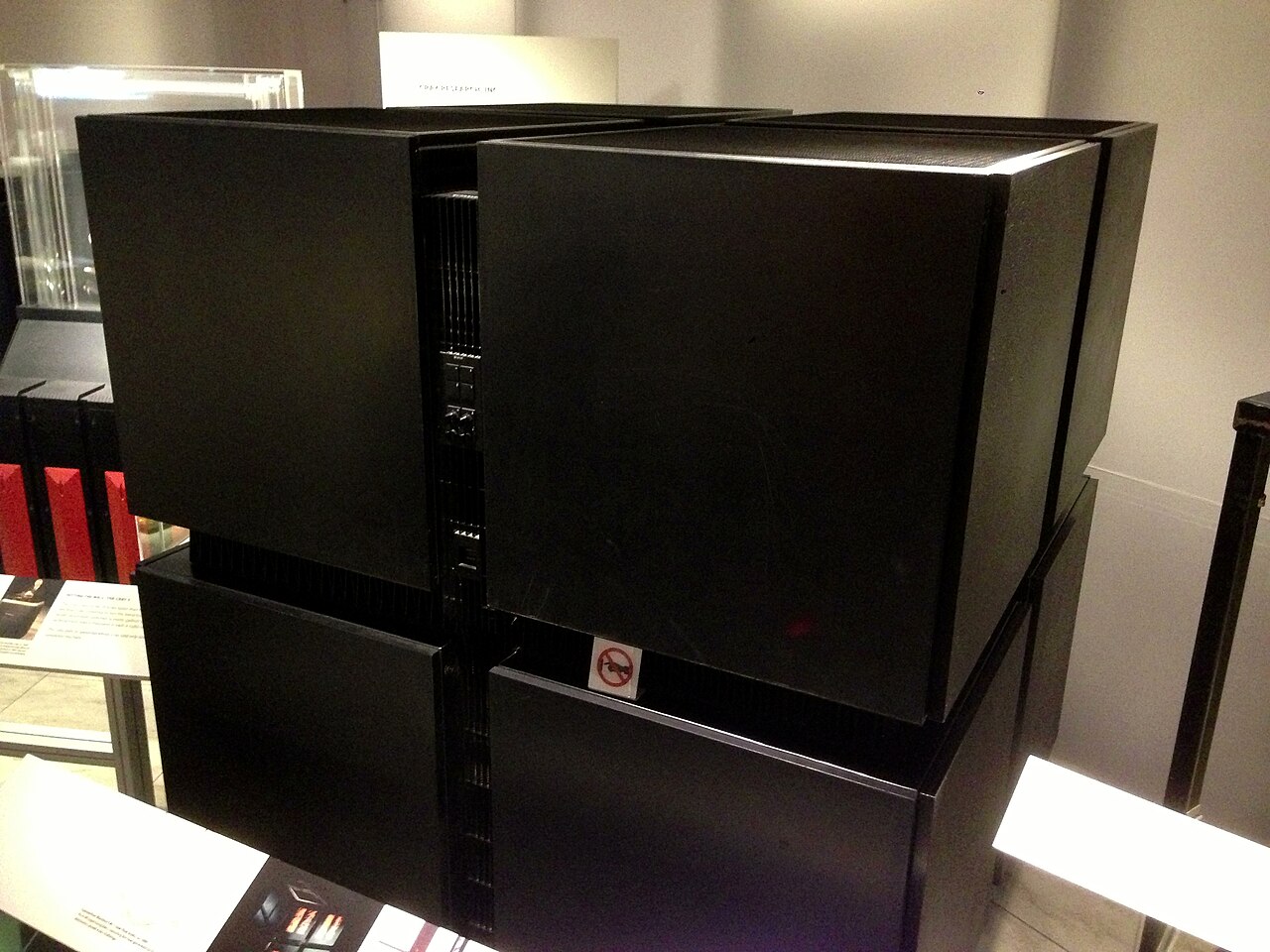
Welcome to this audio tour. Picture a black cube about as tall as a person, with a grid of small red lights glowing through its front panels. The lights flicker in patterns, as if the machine were thinking out loud. That is the Connection Machine CM-1, and it is one of the most striking computers ever made.
[Pause three seconds. The hum deepens.]Thinking Machines Corporation introduced the CM-1 in 1986. It had 65,536 processors. That is the number to hold in your mind. Most computers of its day had one. This one had tens of thousands, all working at the same time. In the next few minutes we will look at why anyone would build such a machine, how it worked, and why it stopped selling.
[Sound of a heavy door latching shut.]Let us begin with the person behind it. Danny Hillis was a graduate student at the Massachusetts Institute of Technology in the early 1980s. He worked in the artificial intelligence laboratory, and he was frustrated. He felt that computers were built around a bottleneck.
Nearly every computer since the 1940s followed one pattern. A single processor fetches a piece of data from memory, does one operation, and sends the result back. Then it does it again. The processor may be fast, but it handles one thing at a time. Hillis called the path between the processor and memory a narrow pipe, and he wanted to remove it.
His idea was to use many small processors, each with its own small memory, and to let all of them work at once. He compared the human brain, in which billions of slow cells work side by side and together solve problems quickly. A computer, he argued, could do the same. In 1983 he and a group of colleagues started Thinking Machines to build it.
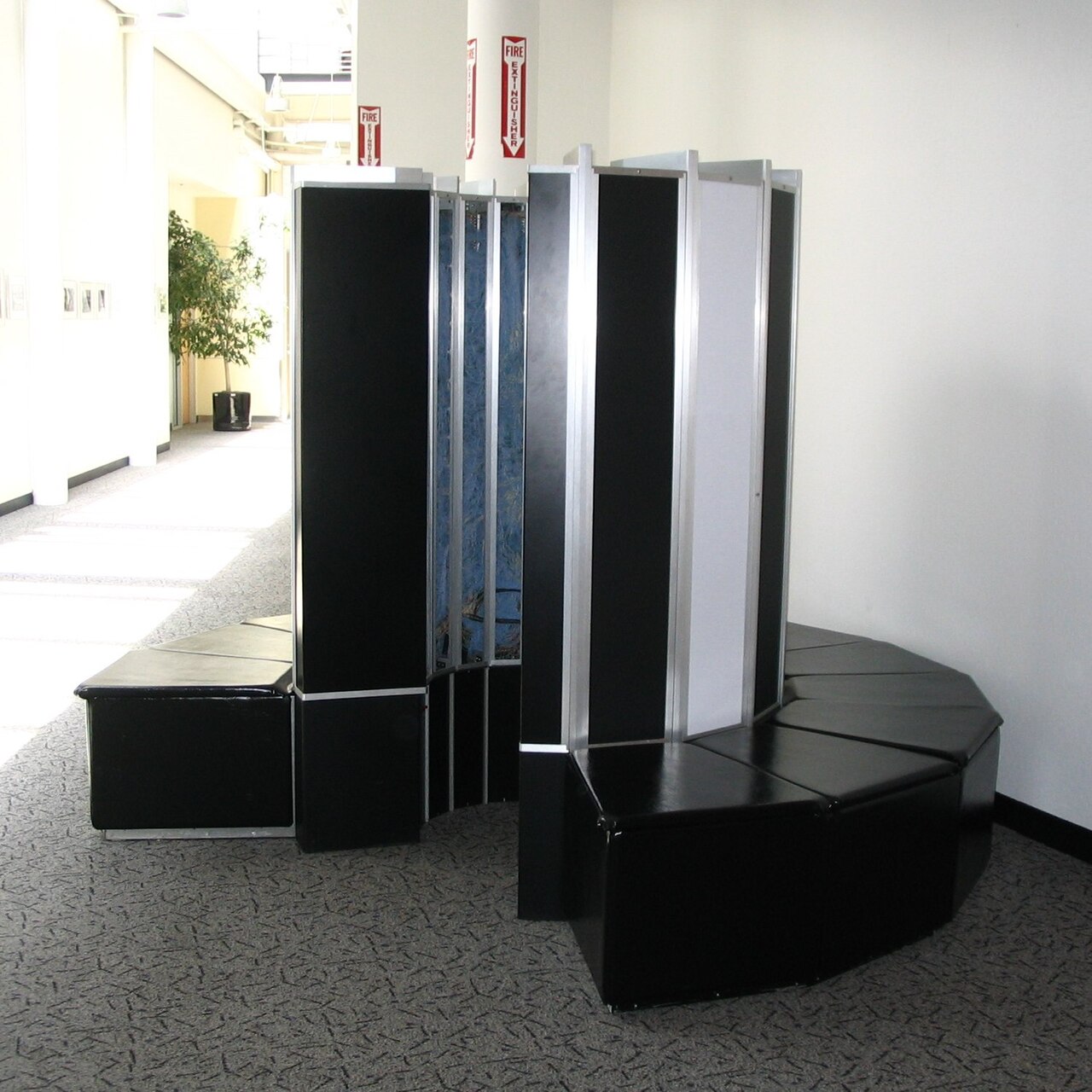
[A slow, pulsing synthesizer note begins under the voice.]Now take a step closer to the cube. Look at its surface and its shape. In the 1970s, the Cray-1 had curves and cushions. The Connection Machine took the opposite approach. It is a sharp-edged black cube, and that choice was deliberate.
The company hired an industrial designer named Tamiko Thiel. Her task was to make the machine look like what it did. The result is a cube made of eight smaller cubes, two on each side. Each smaller cube held a share of the processors. The shape echoes the way the processors were connected inside, which we will come to in a moment.
Thiel chose black so that the machine would look solid and calm. Then she added the red lights. Each light showed activity in part of the machine. When a program ran, patterns of light moved across the panels. A program working through a search lit up in waves. A machine sitting idle showed a different pattern. Researchers could glance at the cube and get a rough sense of what the computer was doing.
[Sound of many tiny clicks, like soft rain.]Those lights made something visible that is normally hidden. Inside a conventional computer, you cannot see the work. Here, you could watch it. For visitors, the effect was striking. For the engineers, it was also useful, because a stuck program often showed up as a frozen pattern.
[Music shifts to a steady, technical beat.]Now let us open the case in our minds and look at the parts. The CM-1 had 65,536 processors. Each was very simple. It worked on a single bit at a time, a zero or a one, and it had a small memory of 4,096 bits. By itself, one of these processors was weak. A cheap calculator could do more.
The strength came from numbers. The processors were grouped sixteen to a chip, which makes 4,096 chips. Those chips were wired together as a hypercube.
A hypercube sounds exotic, but the idea is simple. Imagine a square, with a corner at each of four points. Now imagine a cube, with eight corners. Each corner connects to three neighbors. Add another dimension and each corner connects to four, then five, and so on. With twelve dimensions, each chip connected to twelve neighbors. A message could reach any chip in the machine in at most twelve hops. That kept communication fast even with thousands of chips.
[A short rising tone, then silence.]The machine worked in a style that engineers call SIMD. That stands for single instruction, multiple data. A control unit sent one instruction to every processor, and every processor carried it out on its own piece of data at the same moment.
Here is an example. Suppose you want to brighten a picture. Each dot of the picture has a number for its brightness. On an ordinary computer, one processor adds a value to the first dot, then the second, and so on. On the Connection Machine, you place one dot in each processor and give one instruction, add this value. All the dots brighten together, in a single step.
Here is another way to think about it. Imagine searching a beach for a particular grain of sand. A single worker with a magnifying glass looks at one grain at a time. Now imagine sixty-five thousand workers, each looking at one small patch. The search ends very quickly. The Connection Machine was built for problems with that shape, where the same simple step applies to a huge amount of data.
[Gentle chime.]What sort of problems fit? Hillis had in mind artificial intelligence, such as searching a large collection of facts, and simulations, such as the flow of air or fluid, where each small cell of space follows the same rules. Images and databases also fit well. Researchers used the machine for work in graphics, in physics and in language processing.
[Music softens.]One more detail about the cube itself. It did not have a screen or a keyboard. It could not be used alone. A person worked at a separate computer, called a front end. Early front ends included a Symbolics Lisp machine and a computer from Digital Equipment Corporation. The front end sent programs to the cube and received the results.
Programmers wrote in languages built for the machine. One was an extension of the Lisp language, called star-Lisp. Another was an extension of the C language, called C-star. These languages let a programmer say, in effect, do this to every item at once. Learning to think that way took practice, because it asks for a different view of the problem.
[Pause two seconds.]Thinking Machines attracted attention far beyond its size. The company worked in Cambridge, Massachusetts, near the university that had produced its founders. It drew talented young engineers and scientists, and some famous visitors. One was the physicist Richard Feynman. He spent time with the company in the summer of 1983 and worked on questions about how the machine's network would behave. Colleagues later wrote about his curiosity and his habit of tackling the details himself.
Buyers included universities, research laboratories and government agencies. A Connection Machine cost several million dollars, which put it out of reach for most users. But for the groups that bought one, it opened new kinds of experiments.
[Soft ticking, like a slow clock.]A word on cost and size. The cube stood roughly five feet on each side, and it needed a steady supply of power and cooling, along with a front-end computer, storage and a trained staff. Buying one was a commitment for a laboratory, not just a purchase. Prices ran to millions of dollars, and published figures vary by configuration.
Users learned quickly that the hardest part was not the machine but the plan. Before writing any code, a team asked how to spread the data across the processors. A good layout kept neighbors close together, so messages hopped a short way. A poor layout sent messages across the whole cube and wasted time. This lesson, that where you place data matters as much as how you compute on it, still guides programmers today.
If you are using this script in a classroom, pause here and ask students to guess how many helpers they would need to sort a deck of cards quickly. Let them try with two helpers, then ten. They will see for themselves why more workers help only when the job splits cleanly, and why the layout of the work matters.
[A slow, reflective tone begins.]So why do we not see black cubes in every data center today? The story has several parts.
First, the machine was hard to program. Thinking in parallel is not natural for most people. Many problems do not split neatly into thousands of identical steps. If your problem did not fit, the machine sat mostly idle.
Second, the first model's processors were very simple. They handled one bit at a time, so arithmetic on large numbers was slow. Later models in the family, such as the CM-2, added special hardware for faster number crunching, and the CM-5 changed the design again, using more conventional processors.
Third, ordinary processors kept getting faster and cheaper. Many buyers found that a group of regular workstations, or a conventional supercomputer, could do the same work at a lower cost. The market for such expensive machines was small, and competitors fought for it.
The company struggled with this squeeze. In 1994 Thinking Machines filed for bankruptcy protection. It later continued as a smaller business focused on software.
[The tone brightens a little.]But the story is not only about failure. The ideas of the Connection Machine spread. Today a graphics processor has thousands of small cores that run the same program on different pieces of data. Machine learning depends heavily on that style of computing. The designs differ greatly in detail, and many people contributed to them, but the central idea of doing one thing to a great deal of data at once is shared with the Connection Machine.
That idea turned out to be right, even if the particular machine did not survive. Hillis wanted to escape the narrow pipe. The industry eventually did so, though by a somewhat different road.
[Quiet hum returns.]Before you move on, take one last look at the cube and its red lights. Think about what the lights stand for: tens of thousands of tiny workers acting together. Think too about the choice to make that activity visible. The designers could have hidden the machine in a gray box. They chose to show the work.
Here are three questions to carry with you. First, which jobs in your life are better done by many helpers at once than by one fast helper? Second, why might a designer choose to make a computer's activity visible? Third, what makes a good idea fail in the market while it succeeds in the long run?
[The hum fades out and a single soft chime rings. Silence.]References and Further Reading
- Hillis, W. Daniel. The Connection Machine. MIT Press, 1985.
- Thiel, Tamiko. Writings and design notes on the Connection Machine, at her own website.
- Hillis, W. Daniel, and Guy L. Steele Jr. "Data Parallel Algorithms." Communications of the ACM 29, no. 12 (1986): 1170–1183.
- Computer History Museum. Collection records on the Thinking Machines Connection Machine.