The Cray-1 was the fastest computer of its day, and it looked like furniture. Seymour Cray built it in 1975 and 1976 to run scientific programs faster than any other machine could. He reached that goal by shortening every wire, cooling the chips with liquid and teaching the processor to work on whole lists of numbers at once. This story explains each of those three ideas and what they meant for science.
A laboratory in a small town
Seymour Cray grew up in Chippewa Falls, a small town in western Wisconsin. He studied electrical engineering and applied mathematics, then worked at Engineering Research Associates and later at Control Data Corporation in Minnesota. At Control Data he designed the CDC 6600, which many historians call the first supercomputer. He also led the design of its faster successor, the CDC 7600.
In 1972 Cray left Control Data and started Cray Research. He chose to work in a laboratory in Chippewa Falls, far from the company's offices. Accounts of the period say he liked the quiet and wanted a small team. That team built the Cray-1 in about three years.
The machine was not built for offices or schools. Its buyers were government laboratories and weather centers that ran large simulations. Those users needed speed above all else, and they were willing to pay a high price for it.
The geometry of speed
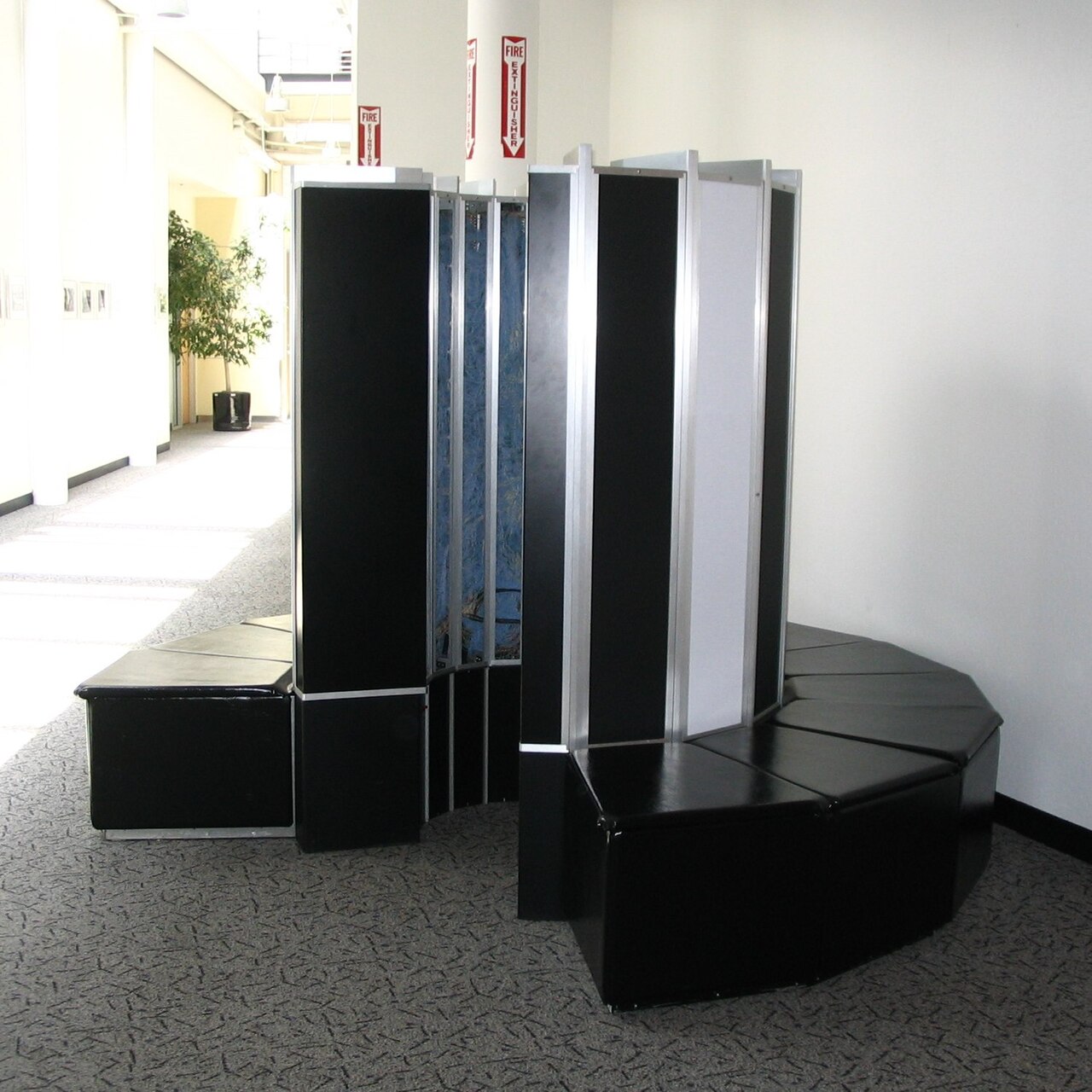
The first thing visitors notice is the shape. The main tower stands in a ring of about 270 degrees, like the letter C seen from above. A padded bench runs around the outside of the base. Many people assume the design is for style. It is not. The shape comes from a physics problem.
An electrical signal travels down a wire at a fraction of the speed of light. At the Cray-1's clock speed, one tick lasts 12.5 billionths of a second. In that time a signal can travel only a few feet. If a wire is longer than the distance a signal can cover in one tick, the machine must wait for it. Long wires therefore slow a fast computer down.
Cray solved this by curving the computer. The circuit modules stand in columns around the ring, so the inside edge is short and the wires between modules stay short. The longest wires in the main frame measured about four feet. The circular layout kept the parts close together and let the computer run at a pace that a straight cabinet could not match.
The wires themselves were cut to exact lengths. Technicians twisted pairs of wires together to reduce interference. Even a small difference in length could change when a signal arrived, so the team treated wire length as a design choice, not an afterthought.
Simple parts, carefully chosen
The Cray-1 used integrated circuits, but not the newest or most complex ones. Cray picked a small set of chip types. Most of the logic used one simple kind of gate. Memory used standard small memory chips. The fast switching came from a style of circuit called emitter-coupled logic, or ECL. ECL switches quickly, but it uses a lot of power and gives off a lot of heat.
Using few kinds of chips made the machine easier to build and repair. A technician learned a small number of parts. A bad module could be pulled out and replaced. The machine contained more than one hundred thousand chips in total. The exact count depends on whether you count memory chips, and published sources give different numbers.
The chips were mounted on circuit boards, and the boards were paired into modules. Each module slid into a column. The result was dense, and the density mattered. It kept wires short, but it also trapped heat. That led to the next problem.
The Freon heart
The Cray-1 drew roughly 115 kilowatts of power. That is about as much as dozens of homes use on a cool day. Nearly all of it became heat inside a space about the size of a closet. Fans could not remove that much heat from tightly packed chips.
Cray used a refrigerant, a liquid sold under the name Freon. Each module was held against a metal cold bar. Thin tubes ran through the bars and carried the refrigerant. The refrigerant took up heat from the bars and carried it down to the base. There, a heat exchanger passed the heat to chilled water, which carried it out of the room.
The padded bench was part of this system. It hid the power supplies and the plumbing that ran the cooling loop. The bench was therefore both a seat and a service cabinet. Cray Research offered customers a choice of colors for the cushions.
The cooling design had a price. A site needed a chilled-water plant, a raised floor and trained staff. Many buyers built a special room for the machine. The Cray-1 was a building project as much as a purchase.
Vector processing
The third idea changed how programmers think. Most computers of the time worked on one number at a time. A program that added two lists of one hundred numbers had to fetch an instruction, fetch two numbers, add them and store the answer, one hundred times.
The Cray-1 had vector registers. A vector register held 64 numbers in a row. The machine had eight of them. One instruction could tell the processor to add every number in one register to the matching number in another. The hardware then streamed the numbers through its arithmetic units one after another, without fetching a new instruction each time.
This approach fits scientific work well. Weather models, fluid flow and structural analysis all repeat the same arithmetic across large grids of numbers. Where a program could be written in this style, the Cray-1 ran it very quickly.
The machine also used a trick called chaining. The result of one vector operation could flow straight into the next operation before the first one had finished. For example, numbers could be multiplied and then added in a single continuous stream. Chaining kept the arithmetic units busy and raised the real speed of programs.
Vector instructions worked alongside ordinary scalar instructions. Scalar registers handled single numbers, and address registers handled memory locations. Fast backup registers sat between the processor and main memory. This design let one program mix long vector loops with the single-number work that every program has.
What the numbers mean
The headline figure is 160 megaflops. A flop is one floating-point operation, such as one addition or one multiplication of decimal-style numbers. The Cray-1 could in theory finish 160 million of them each second. The figure comes from the machine's add and multiply units, each able to finish one result per tick of the 80 MHz clock, so 80 million plus 80 million equals 160 million.
That is a peak rate, not an average. Real programs reached much less, because they also move data and wait for memory. Reports from users at the time suggest that careful code could come close to half of the peak, while ordinary code could fall far below it. The gap between peak speed and real speed is still a central topic in high-performance computing.
For comparison, a modern phone processor can perform billions of operations each second. The Cray-1 is slow by that standard. In the 1970s it was the leader by a wide margin over the CDC 7600 and other contemporaries.
Software for a vector machine
A fast computer is only useful if people can program it. Cray Research supplied an operating system, called COS, and a Fortran compiler. Fortran was the main language of scientists and engineers. The compiler looked for loops that worked on arrays of numbers and turned them into vector instructions without the programmer asking.
This was an important part of the product. Scientists did not need to learn a new language. They could keep their Fortran programs and often gain speed after small changes. When a loop could not be vectorized, the compiler said so, and programmers learned to rewrite code so that it could be. Over time, writing for vector hardware became a skill of its own.
The machine also checked its own memory. It used an error-correcting scheme that could fix a single flipped bit and detect two. Engineers added it because memory errors on a machine this large would have ruined long jobs. The feature also became a point of pride for the design team.
The first customers
Los Alamos National Laboratory in New Mexico received the first production machine in 1976. According to commonly repeated accounts, the laboratory took the machine for a trial period before it agreed to buy. The reported price was about 8.8 million dollars. The price shows how much the laboratory valued speed for its simulations.
Another early customer was the National Center for Atmospheric Research in Colorado. It chose the Cray-1 for weather and climate models. The center's decision mattered because it was a civilian science customer. It showed that the machine had a market beyond defense laboratories.
Over the following years, Cray Research sold dozens of Cray-1 family machines to laboratories, universities, energy companies and national weather services. Sources count roughly eighty units in the family, including improved models called the Cray-1S and Cray-1M, which offered more memory. Exact totals vary by source, so treat that figure as approximate.
The company succeeded quickly. It went public in 1976 and became one of the best-known names in computing. The Cray-1's success also set a pattern. For about a decade, a supercomputer meant a vector machine, and many buyers asked first whether a design could match Cray's.
Science the machine made possible
Weather prediction was one of the clearest uses. A forecast model divides the atmosphere into a grid of boxes and calculates how air, heat and moisture move from box to box. Smaller boxes give better forecasts, but they multiply the number of calculations. Faster computers let forecasters use finer grids and look further ahead.
Physicists used the machine for simulations that were too costly to test in a laboratory. Engineers used it to model airflow over aircraft and the stress in structures. Oil companies used it to interpret data about rock layers beneath the ground. In each case, the same kind of arithmetic repeated across large arrays, and the vector design suited it well.
Many of these uses are described in general terms in sources, and specific claims about firsts are hard to verify. For that reason this story does not name a single "first" simulation. It describes the kinds of work that vector supercomputers made practical.
The man behind the machine
Cray had a reputation for working alone and thinking in physical terms. Stories about him describe a quiet engineer who preferred to sketch designs by hand and who took long walks and dug tunnels on his property as a way of thinking. Those stories appear in biographies, and some are told with a bit of legend. What is solid is that he led a small team to a design that bigger organizations could not match.
Cray also believed in small teams. He wanted a few capable people to own a design from beginning to end. This was unusual in the 1970s, when computer projects often involved large groups. The Cray-1 became a case study in how a focused team can outperform a larger one.
Descendants
Cray Research followed the Cray-1 with the Cray X-MP in 1982, which used several processors that shared memory. The Cray-2, designed by Cray himself, used a different cooling method in which the circuit boards sat in a bath of liquid. Vector machines remained important through the 1980s. In the 1990s, supercomputers moved toward large numbers of ordinary processors working in parallel, and vector designs became less common.
The ideas lived on. Modern graphics processors and the vector instructions in everyday processors both work on groups of numbers at once. The Cray-1 did not invent the concept, and earlier machines had explored it, but it made the approach practical and widely known.
Seeing one today
Several museums display Cray-1 machines, and the Computer History Museum in California is one of them. Visitors can walk around the tower and see the cushions, the cooling base and the dense columns of modules. The design looks different from every angle, and photographs do not show how small the tower is. It stands about as tall as a person, and the whole machine fits in a modest corner of a room.
Anyone planning an exhibit that mentions the Cray-1 can use three questions as a guide. Why is the machine round? How does the machine stay cool? Why can one instruction handle a whole list of numbers? Each question leads to a clear and testable answer, and each connects to ideas that students meet in physics and mathematics classes.
Life in the machine room
Running a Cray-1 took a team. Operators loaded jobs, watched the cooling system and answered alarms. Field engineers kept spare modules on hand, because a failed module stopped the whole machine and every hour of downtime cost the site a great deal of money. Staff learned to swap a module quickly and then test the removed one on a bench.
Users rarely saw the machine. They sent jobs from terminals in other buildings and picked up printed results later. A scientist might wait hours for a run to start and then see it finish in minutes. The scarce resource was machine time, so laboratories set strict schedules and asked users to justify their requests.
Because the computer was so costly, programmers cared about every second of its use. They timed their loops, rearranged arrays and tested small cases on slower machines first. This habit of careful tuning spread through high-performance computing and still guides programmers who work on today's largest systems. It is one more way the Cray-1 shaped the field.
Why it matters
The Cray-1 shows that speed is the product of many small choices that reinforce each other. Short wires allowed a fast clock. A fast clock produced heat. Liquid cooling removed the heat. Vector registers made good use of the speed. Remove any one of these and the others lose their value.
It also shows how a hardware design shapes the software and the science that follows. Programmers rewrote code to suit vector hardware. Scientists asked questions that fit what the machine could do. The shape of the tool shaped the work.
References and Further Reading
- Russell, Richard M. "The CRAY-1 Computer System." Communications of the ACM 21, no. 1 (January 1978): 63–72.
- Murray, Charles J. The Supermen: The Story of Seymour Cray and the Technical Wizards Behind the Supercomputer. John Wiley & Sons, 1997.
- Cray Research, Inc. CRAY-1 Computer System Hardware Reference Manual. 1976.
- Computer History Museum. Collection records and exhibit materials on the Cray-1.