The suitcase that started it
Today a computer slips into a backpack or a pocket. In 1981 the first successful portable computer weighed nearly 25 pounds and came in a case the size of a small sewing machine. You carried it by a handle and set it down on a table. The Osborne 1 was awkward by any modern measure, yet it showed that people would pay for a computer they could take with them.
An author becomes a manufacturer
Adam Osborne was born in Thailand in 1939 and raised partly in India and England. He trained as a chemical engineer and then became a writer and publisher of computer books. His book An Introduction to Microcomputers, first published in the 1970s, explained the new microprocessor chips to a wide audience and sold very well. He understood what ordinary users wanted from a computer, and he understood what annoyed them.
In 1980 he founded Osborne Computer Corporation. He wanted a machine that a business person could buy as a single package, learn quickly and carry to a customer's office. He hired the engineer Lee Felsenstein, a well-known figure in the Bay Area computer community, to design it. Felsenstein produced a compact design in a few months. He kept the parts count low and chose common components, which helped the company build the machine quickly and at a price that small businesses could afford.
What was in the case
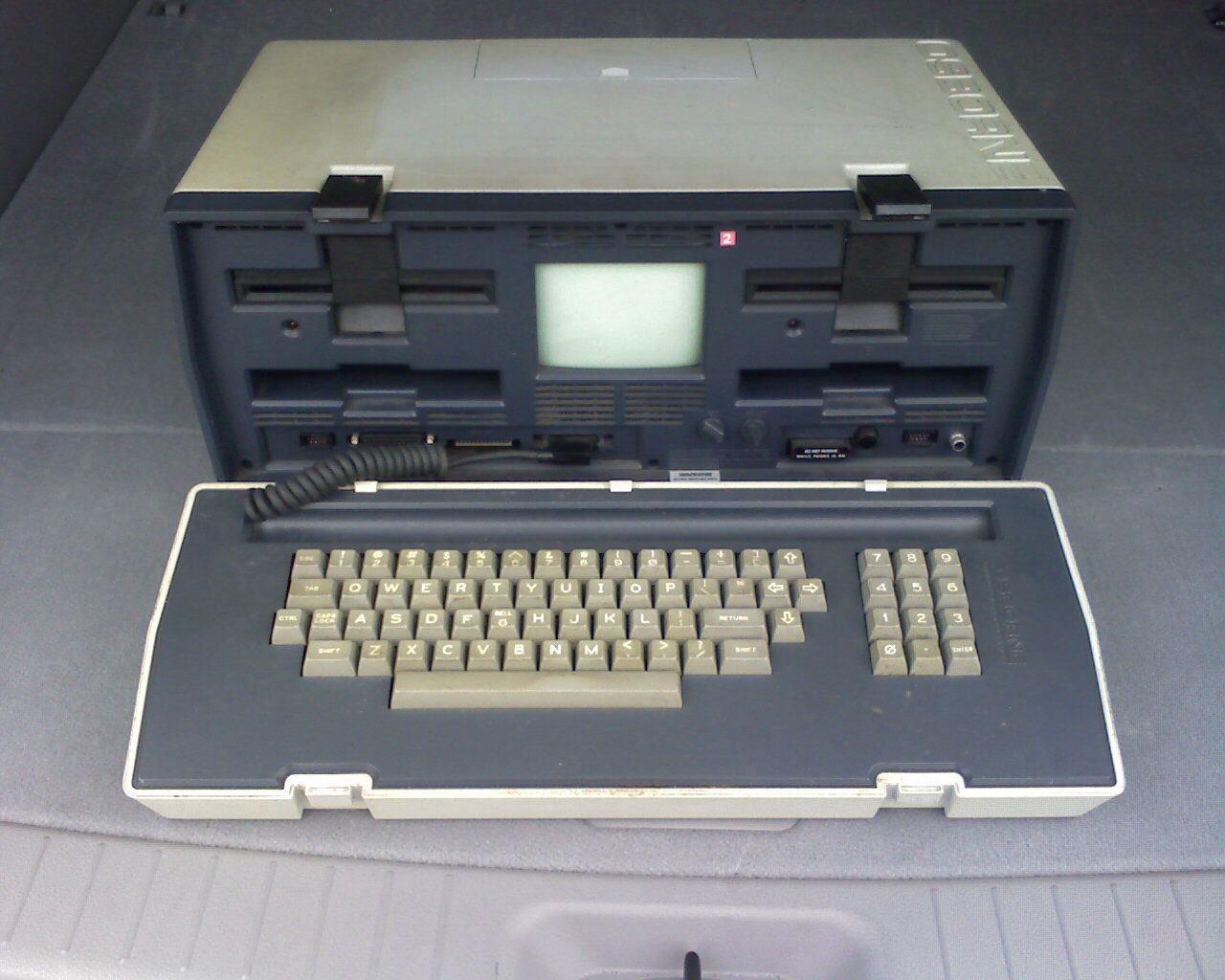
The Osborne 1 was announced in April 1981 at the West Coast Computer Faire in San Francisco. It was a self-contained machine. The lower part of the case held the electronics and two floppy disk drives. The lid on the front folded down to become the keyboard, which was attached by a cable. In the middle sat a screen only five inches across, showing 52 columns of text by 24 lines. A user who needed 80 columns, the usual width for business work, could scroll the small window sideways across a wider page.
The bundle
The feature that made buyers pay attention was the software. Before the Osborne, a business computer buyer purchased the hardware and then bought programs separately, often for hundreds of dollars each. Osborne included a set of the most useful programs in the price. The package contained the CP/M operating system, the WordStar word processor, the SuperCalc spreadsheet and two versions of BASIC. Osborne said the programs would cost much more than a thousand dollars if bought on their own.
The approach is easy to recognize today. Phones and laptops arrive with a set of working applications already installed, and the buyer starts to use them at once. The Osborne 1 was an early example of selling a complete, ready-to-use tool in place of a kit of parts.
Life with a luggable
People called machines like the Osborne "luggables" or "transportables," since carrying one was a chore. It fitted under an airplane seat, just about, and travelers who owned one learned to be patient with security staff. It needed a wall outlet, because it had no battery. There was an optional battery pack, but most users plugged it in.
The screen was small, and the display was dim. Users peered at it, and some bought magnifying lenses. The drives held little data, so people swapped disks constantly. Still, a traveling salesperson or a writer could carry a full set of tools into the field, and many did. A reporter could file a story from a hotel room, and an engineer could update a spreadsheet at a customer site.
Success, then trouble
The Osborne 1 sold well. The company grew from a small start to produce thousands of machines a month during 1982, which made it one of the fastest-growing companies of its time. Competitors followed, including the Kaypro II, a similar portable with a larger screen. Osborne had shown that the market was real.
The company then ran into problems. Quality control suffered during the rapid growth, and rivals produced better machines. In 1983 Osborne announced the next generation, the Executive and the Vixen. The new models were more capable, but they were not ready to ship. Dealers and customers, hearing about the better machines, stopped buying the Osborne 1. Revenue collapsed before the new machines arrived. The company filed for bankruptcy protection in September 1983.
The Osborne Effect
The episode gave rise to a term that business writers still use: the Osborne Effect. It describes a company that harms its sales by announcing a future product too early, so that customers wait. Historians debate how much the early announcement truly caused Osborne's failure. Late products, falling prices, cash problems and changes in the market also played a part. The name has stuck anyway, and it serves as a warning for any firm planning a launch.
Legacy
The Osborne 1 did not survive, but the idea did. Compaq introduced a portable IBM-compatible computer in 1983, and its success showed the value of a machine that could run the same programs as the office desktop. Over the following decades, portable computers shrank from luggables to laptops, notebooks, tablets and phones. The weight of an Osborne is now the weight of a bag of books.
The bundle idea also endured. The machine reminds us that people buy computers to do tasks, and that a tool that is ready to work often beats a tool that is merely powerful.
For discussion
- What would you give up to carry a computer everywhere, and what would you insist on keeping?
- Why might announcing a better product in advance hurt a company? When might it help?
- Which features of the Osborne 1 would you recognize on a device you own?
References
- Freiberger, Paul, and Michael Swaine. Fire in the Valley: The Making of the Personal Computer. McGraw-Hill, 2000.
- Levy, Steven. Hackers: Heroes of the Computer Revolution. Anchor Press, 1984.
- Osborne, Adam, and John Dvorak. Hypergrowth: The Rise and Fall of Osborne Computer Corporation. Idthekkethan Publishing, 1984.
- Computer History Museum. Collection records and oral history for the Osborne 1.