Standards alignment
This lesson supports the history and impact strands of the Georgia Standards of Excellence for computer science, and the strands on how technology changed the American economy and society after 1945 in United States history. Teachers should check the current standard numbers on the Georgia Department of Education website and match them to their own course.
Learning objectives
Students will be able to:
- Describe the Altair 8800 and explain why hobbyists wanted it.
- Explain how a person programmed the Altair using switches and binary numbers.
- Describe how the Altair led to new companies, including Microsoft.
- Compare the shift from shared institutional computers to personally owned ones.
Activity 1: The toggle-switch challenge (20 minutes)
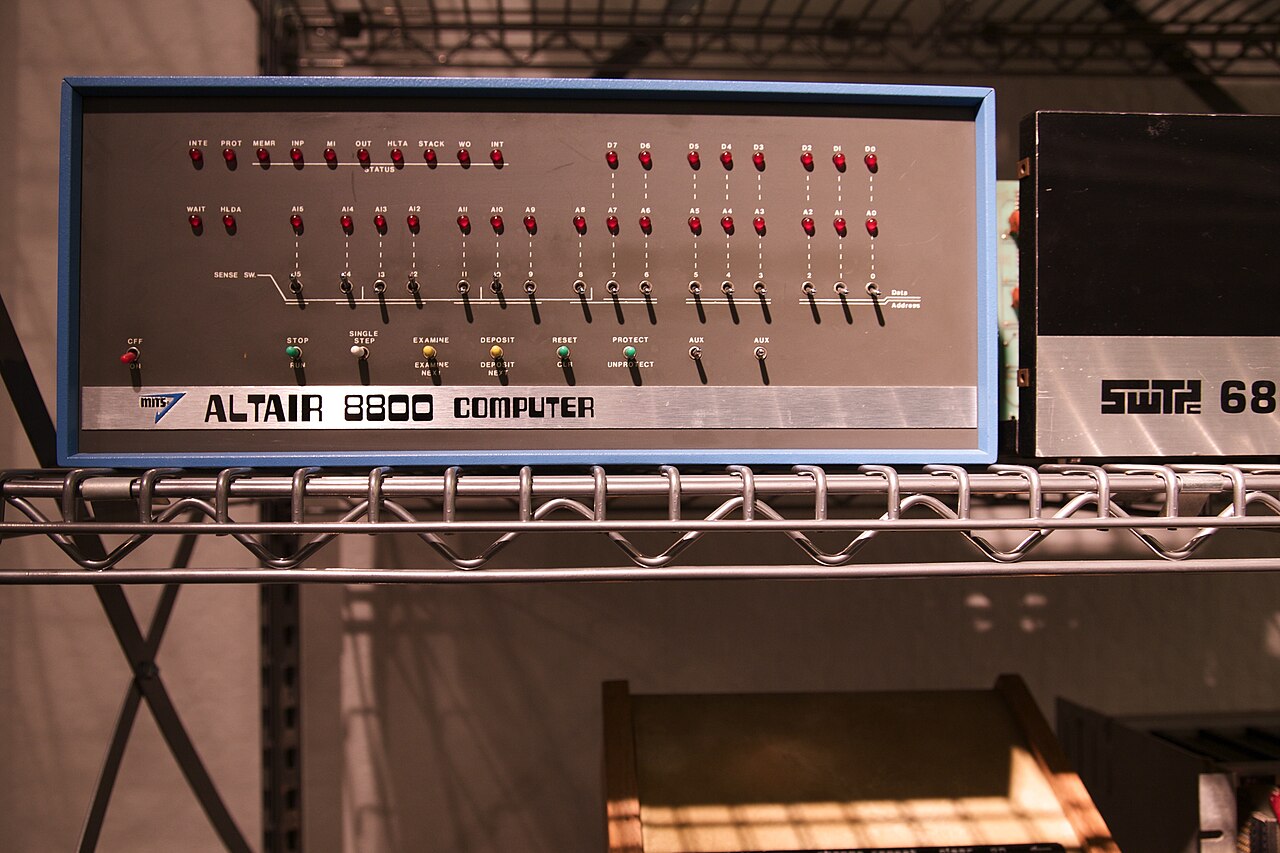
Give each pair a paper template of the Altair front panel, with a row of eight switches for data. Students will "enter" a tiny program by marking which switches are up and which are down.
- Show how one byte becomes a row of eight switches. Up means 1, down means 0.
- Give the pair a short list of codes and what each one means, written by the teacher for this exercise. For example, one code can mean "load a number," another "add," and another "stop."
- Ask the pairs to enter a program that adds 2 and 3. One student reads the codes aloud and the other marks the switches.
- Swap roles, and then deliberately make one error. Ask how long it takes to find it.
Reflection: The real machine required flipping switches for every instruction and storing each one in memory by pressing a key. How many switch moves would a program of 100 instructions need? What does this say about the patience of the first users?
Activity 2: Reading the magazine (15 minutes)
Share excerpts from the January 1975 issue of Popular Electronics, available in digitized archives. Students read the cover line and the opening paragraphs and answer three questions.
- Who is the intended reader? What clues in the text tell you?
- Which claims in the article are about price, size or power? Which are about promise?
- Why might a small box of switches have excited readers so much?
Background for the teacher
In the early 1970s, computers were large, costly and shared. A company or university owned one, and users reached it through an operator or a terminal. Owning a computer at home was not realistic for almost anyone. That began to change in 1971, when Intel introduced the first microprocessor, a computer processor on a single chip. In 1974 Intel followed with the 8080, a faster and more capable chip.
Ed Roberts ran a small company in Albuquerque, New Mexico, called Micro Instrumentation and Telemetry Systems, or MITS. It had begun by selling parts for model rockets, then moved to electronic calculators. When larger companies cut calculator prices sharply, MITS fell deeply into debt. Roberts bet the company on a computer kit built around the new 8080 chip.
The machine
The Altair had no keyboard and no screen. The front panel carried rows of toggle switches and small red lights. To run a program, the user set the switches to the binary pattern for one instruction, pressed a key to store it in memory and repeated this for each instruction. When the program ran, the lights showed the result. A mistake meant starting over. Turning off the power erased everything in memory.
Even so, it cost less than many calculators sold to businesses, and it was a real computer. Hobbyists who had read about computers could finally own one. The kit also had expansion slots, so owners could add memory, a terminal connection, a tape drive and other devices.
The magazine cover
The January 1975 issue of Popular Electronics put the Altair on its cover with a headline about a minicomputer kit that could rival commercial models. According to a widely told story, the original prototype was lost in shipping to the magazine, and Roberts supplied an empty case for the photograph. Historians repeat the story with care, and the details vary between accounts. What is certain is that the article reached many readers who were ready to build.
Roberts had hoped to sell perhaps a few hundred kits. Orders came in by the thousands within weeks, and MITS struggled to deliver. Customers waited months. Even so, the Altair showed that a market existed, and other firms started to make competing machines.
Software and the birth of a company
Hardware needed programs. Two young programmers, Bill Gates and Paul Allen, read the article and thought that the machine needed a version of the BASIC programming language. They contacted MITS and said they had one. They did not yet. Working with another Harvard student, Monte Davidoff, they wrote the language on a large computer at Harvard, using a program that imitated the 8080. In early 1975 Allen flew to Albuquerque and demonstrated the result. It worked.
MITS agreed to sell the software, and Gates and Allen formed a partnership that became Microsoft. Altair BASIC let owners type programs on a terminal instead of flipping switches. It gave them a reason to buy memory and a terminal board. It also started a debate about whether software should be paid for or shared, after hobbyists copied the tape freely.
A bus, a club and a community
The Altair used a set of connectors and wires inside the case that carried signals between the processor and the add-in boards. Other companies built boards for it. The standard that grew out of this became known as the S-100 bus, and clones of the Altair, such as the IMSAI 8080, used it. The result was the first ecosystem of personal computers, in which many firms made compatible parts.
Hobbyists also gathered. In March 1975 the Homebrew Computer Club began to meet near Stanford University in California. Members shared news, swapped circuits and showed what they had built. Steve Wozniak attended and was inspired to design the computer that became the Apple I.
Discussion
- The price put a computer within reach of hobbyists. Who still could not afford one? Who decided that computers were for "everyone"?
- Compare switches and lights with a touchscreen. What can you control with the first that you cannot with the second?
- A failing calculator business led to a new industry. What does this say about how invention happens?
- Why might sharing ideas in a club speed up a new technology?
Assessment
Ask students to write a one-page letter, in the voice of a hobbyist in 1975, to a friend describing why they ordered an Altair and what they hope to do with it. The letter should include at least three accurate facts from the lesson and one honest complaint about the machine.
Further Reading and Sources
- Ceruzzi, Paul E. A History of Modern Computing. MIT Press, 2003.
- Freiberger, Paul, and Michael Swaine. Fire in the Valley: The Making of the Personal Computer. McGraw-Hill, 2000.
- Roberts, H. Edward, and William Yates. "Altair 8800: World's First Minicomputer Kit to Rival Commercial Models." Popular Electronics, January 1975.
- Computer History Museum. Collection records and exhibit materials on the MITS Altair 8800.