In February 1946 the University of Pennsylvania showed reporters a machine that filled a large room. It was called ENIAC, short for Electronic Numerical Integrator and Computer. It had about 17,500 vacuum tubes, weighed about 30 tons and ran on roughly 150 kilowatts of electric power. The US Army had paid for it to solve one kind of problem faster: the tables that told artillery crews how to aim.
The story has two halves. One half is about the engineers who built ENIAC and the hardware they invented to make thousands of fragile tubes work together. The other half is about the six women who figured out how to make it do useful work. Their job did not have a name yet. Today we call it programming.
A war that needed arithmetic
Aiming a large gun is a math problem. The angle depends on the weight of the shell, the powder charge, the wind, the air density and the height of the target. Gunners in the field did not solve the equations. They looked up the answer in a firing table, a thick booklet printed for each gun and each type of shell.
Every line in a firing table came from one calculated trajectory, and one trajectory took many steps. The Army's Ballistic Research Laboratory at Aberdeen Proving Ground in Maryland had a staff of human "computers", mostly women with mathematics training, who worked with desk calculators. Accounts differ on how long one trajectory took by hand. Figures between 20 and 40 hours appear in the sources. The Laboratory also had a differential analyzer, a mechanical machine of shafts and wheels that could do the work faster, but not fast enough for the number of new guns and shells that the war required.
By 1943 the backlog of tables was growing. The Army needed a faster way, and it was willing to pay for an unproven idea.
The proposal
John Mauchly was a physicist who taught at the Moore School of Electrical Engineering, which was part of the University of Pennsylvania. In August 1942 he wrote a short memo that proposed calculating with vacuum tubes instead of gears and relays. Tubes switch in microseconds, thousands of times faster than a mechanical part can move.
The memo drew little attention at first. Then Lieutenant Herman Goldstine, an Army mathematician who worked with the Ballistic Research Laboratory and knew the table backlog well, heard about it and pushed it forward. The Army Ordnance Department signed a contract in the summer of 1943. The work was called Project PX. J. Presper Eckert, who was 24 years old and a brilliant circuit designer, became chief engineer. The final cost was close to half a million dollars.
Many engineers doubted that the plan would work. A vacuum tube was known to burn out. A machine with thousands of tubes, they argued, would spend more time broken than running. Eckert addressed the problem directly. He ran the tubes well below their rated voltage and current, and he had them tested before use. His team also left the machine powered on most of the time, because tubes tend to fail when they are switched on and heated. Even so, a tube failed every day or two. The crew learned to find the faulty one quickly, and ENIAC ran for most of its working hours.
What ENIAC was
ENIAC was a decimal machine, not a binary one. It stored each digit in a ring of ten tubes, and only one tube in the ring was lit to show the digit. Twenty units called accumulators each held a ten-digit number and could add. Other units handled multiplication, division and square roots. Punched-card machines from IBM read data in and punched results out.
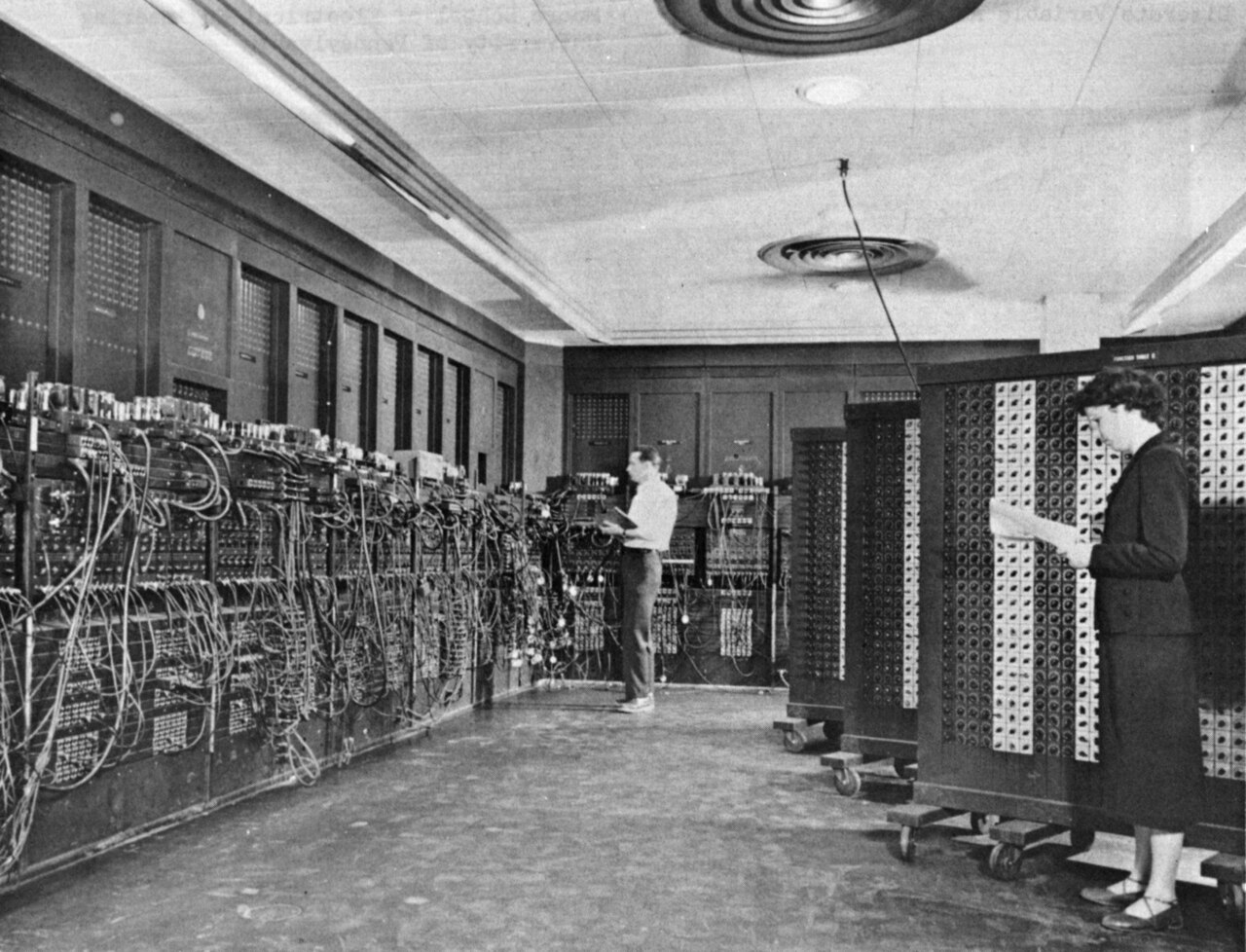
It was fast for its day. It could perform about 5,000 additions per second and about 357 multiplications per second. The machine was arranged in a U shape around a room at the Moore School, with panels about eight feet tall along the walls. Roughly five million soldered joints connected its parts, and most of those were soldered by hand.
Its builders had designed it for artillery tables, but they made it general enough to solve other problems. The first job that ran on ENIAC in late 1945 and early 1946 had nothing to do with artillery. It was a calculation for scientists at Los Alamos who were studying the feasibility of the hydrogen bomb, and the work had been arranged through the mathematician John von Neumann. The problem was so large that it could not have been done in a reasonable time by any other means.
No stored program
The feature that surprises modern readers is that ENIAC had no program in memory. A modern computer loads instructions from storage. ENIAC did not. The instructions were the wiring.
To set up a problem, a programmer used patch cables, like those of a telephone switchboard, to connect the output of one unit to the input of another. She also set rows of switches, called function tables, to hold constants and numeric tables. Changing from one problem to the next meant unplugging and replugging cables and resetting switches across the whole room. A setup could take days. Once it was done, the problem ran in minutes.
Designing the setup was the real work. The programmer had to decide which unit did what and in which order. She also had to make sure that pulses from different units arrived at the right moment. She had to think about the physical layout of the room as much as about the mathematics.
The six programmers
The Army and the Moore School knew that someone would have to set up the problems. They chose from the group of women who already worked as human computers on the project. Six were selected in 1945: Kay McNulty, Betty Jennings, Betty Snyder, Marlyn Wescoff, Fran Bilas and Ruth Lichterman. Betty Jennings later became Jean Bartik, and Betty Snyder later became Betty Holberton. Fran Bilas married and became Fran Spence. Kay McNulty married John Mauchly in 1948.
They had no manual because no one had written one. They studied the machine's wiring diagrams and block diagrams, talked with the engineers and learned by experiment. Some of the machine's work was classified, so the women were at first kept away from the room until the hardware was ready. Several of them trained on IBM punched-card equipment at Aberdeen to learn how data moved through a machine.
The women built the practice of programming from scratch. They divided a problem into steps that the hardware could carry out and drew diagrams to track the flow. They invented ways to check that a setup was right before running it. Historians credit Betty Snyder Holberton and others with early work on subroutines, the idea of reusing a block of setup for a repeated task, and on ways to stop a run midway so that results could be checked. The accounts differ on exactly who did what, but all of them agree that the six together created the working methods of the machine.
At the Army's request the Moore School gave a public demonstration in February 1946. The women prepared the problems that ran that day. The press focused on the machine and its speed. A ballistic trajectory that took a person hours was finished faster than the shell would have flown. Reporters and the official photographers rarely named the women. Bartik later recalled that visitors sometimes assumed the women in the photographs were models posing with the equipment. Historian Jennifer Light studied the Army's wartime and postwar computing labor in a 1999 article and showed how the work of women programmers was treated as clerical, even though it needed real skill.
How a trajectory run worked, in outline
A trajectory calculation shows what the programmers had to design. The method divides the flight of a shell into very small steps of time. At each step the computer works out how air drag slows the shell and how gravity pulls it down. It then updates four numbers: the shell's horizontal position, its height, its horizontal speed and its vertical speed. Then it repeats, often hundreds of times, until the shell lands.
On ENIAC each of those four numbers lived in an accumulator. A function table held the drag values, which depend on the speed of the shell and come from firing tests on a range. The multiplier combined the drag value with the speed. Cables carried the results back to the accumulators, and the master programmer unit counted the steps and decided when to stop. The programmer had to lay out this loop physically. If a result arrived at an accumulator one pulse too early or too late, the answer was wrong.
Checking was a large part of the job. A programmer would run a short test problem whose answer she already knew, compare the numbers digit by digit and look for the error in the wiring. When a result was off, she traced pulses along cables by hand and with test equipment. The engineers could fix a failed tube. Only the programmer could fix a setup that was logically wrong.
Life inside the machine
ENIAC was a hot, noisy and crowded workplace. The racks of tubes warmed the room, so the Moore School installed fans and blowers to pull air through the cabinets. Technicians walked the aisles with spare tubes and a test meter. Lights showed the state of the digit rings, and a trained operator could read a number straight from the glowing tubes.
Repair was part of the daily routine. A technician looked for the failed tube by running diagnostic tests that stopped on the faulty section. Replacing a tube took minutes once it was found. Finding it was the hard part, because a failure in one place could look like a wrong answer somewhere else. Over time the crew learned which tubes and which sockets were most likely to fail, and they kept the machine in service for long stretches.
The shared workspace also taught lessons about teamwork. Engineers and programmers worked side by side, and the women often caught hardware faults that the technicians had missed, because they knew what a correct result should look like. In later computers the roles were separated more sharply, with operators, programmers and maintenance staff on different floors. ENIAC was built when all three jobs were done by a small group in one room.
After the demonstration
The Army moved ENIAC to Aberdeen Proving Ground in 1947. There it ran for years on ballistics, weather prediction, atomic energy, random number studies and wind tunnel design. In 1948 a team led by Richard Clippinger and including Adele Goldstine changed the way it was controlled. They set the function tables to hold coded instructions, and the machine ran from them instead of from the cable setup. This was slower in raw speed but made a new program a matter of changing numbers, not wires. ENIAC thus became a stored-program machine of a kind, years after its first run.
That change followed from a larger idea. In June 1945 John von Neumann circulated a paper, the First Draft of a Report on the EDVAC, which described a computer that kept its instructions and data in the same memory. The proposal drew on talks with the ENIAC team and built on their experience. The EDVAC and other stored-program machines of the late 1940s took that route, and ENIAC's cable and switch method was set aside.
ENIAC was shut down for the last time on October 2, 1955. Parts of it went to museums, including the Smithsonian's National Museum of American History and the University of Pennsylvania.
Who invented the computer?
ENIAC became part of a long legal argument. Eckert and Mauchly filed a patent application in 1947 and received the patent in 1964. Their company, which had by then become part of Sperry Rand, collected license fees. Honeywell challenged the patent. In October 1973 a federal judge in Minneapolis ruled it invalid. The judge held that Mauchly had derived key ideas from John Atanasoff, a professor at Iowa State College who had built a smaller electronic calculating device in the early 1940s and had shown it to Mauchly in 1941.
The decision did not say that ENIAC was a copy. It said that the ideas in the patent were not wholly original. Historians still debate how much to credit Atanasoff, the British codebreakers who built Colossus in 1943 and 1944, and the inventors of earlier calculating machines. A fair reading is that ENIAC was the first large-scale, general-purpose, programmable electronic digital computer to enter regular service in the United States, and that it was one of several machines in a fast-moving field.
Why the six were forgotten
After the war, the history of ENIAC was told as a story of the hardware and its male designers. The women who set up the machine were seldom named in articles or books. Some were never asked for their account. The Army had listed their work as sub-professional, and many people assumed the real genius lay in the circuits.
That began to change in the 1980s and 1990s. Researchers interviewed the surviving women and read their papers. In 1997 the Women in Technology International Hall of Fame inducted the six. Documentary filmmakers and historians brought their story to wider audiences in the 2010s, and the surviving programmers received recognition before they died. Jean Bartik published a memoir in 2013, edited and released after her death in 2011.
The attention helps to correct the record. It also makes a practical point that exhibit designers and teachers can use. Software was not an afterthought to ENIAC. Without the programmers, the machine would have been a very large and expensive collection of tubes. The hardware made the computation possible, and the people who understood the problem made it happen.
Why it matters for a museum
A visitor to a museum gallery can learn four things from ENIAC. First, a computer is more than hardware. Programming is a skill and a body of knowledge that took people years to develop. Second, scale and reliability are engineering problems of their own. Eckert's methods for running tubes conservatively made the whole machine practical. Third, the choices made in a first design shape what comes later. ENIAC's decimal rings and cable setup were replaced because the next generation preferred binary numbers and stored programs. Fourth, credit in history is something people have to work for. The women of ENIAC did the work in 1945 and had to wait decades for the public to hear their names.
References
- McCartney, Scott. ENIAC: The Triumphs and Tragedies of the World's First Computer. Walker, 1999.
- Fritz, W. Barkley. "The Women of ENIAC." IEEE Annals of the History of Computing 18, no. 3 (1996).
- Light, Jennifer S. "When Computers Were Women." Technology and Culture 40, no. 3 (1999).
- Bartik, Jean Jennings. Pioneer Programmer. Truman State University Press, 2013.
- Stern, Nancy. From ENIAC to UNIVAC. Digital Press, 1981.