In the early 1970s, most people who used a computer did so through a terminal. They typed a line of text, waited, and read a line of text back. The computer itself sat in a machine room and served many people at once. A person who wanted one to themselves was either rich or a researcher with unusual friends.
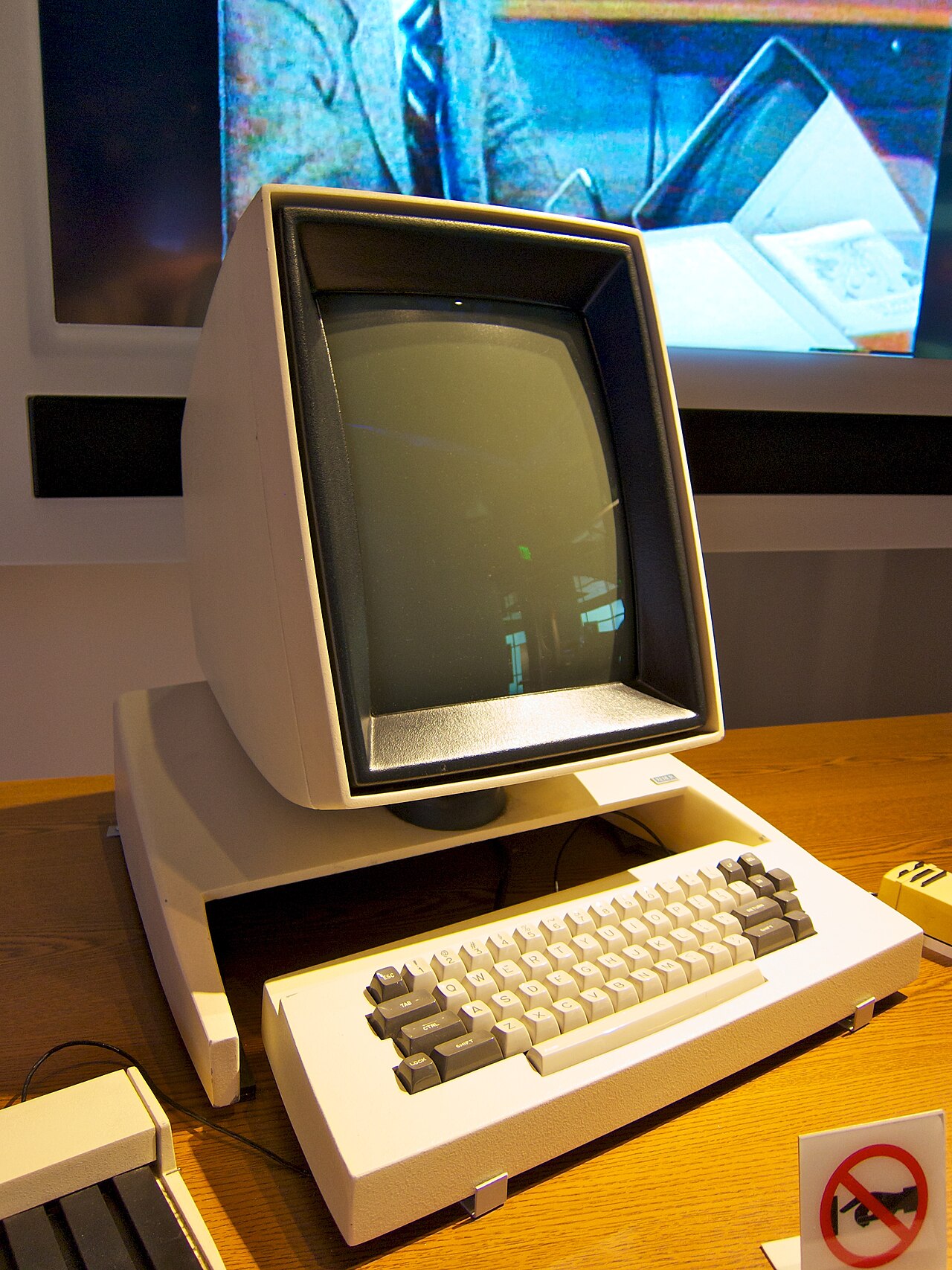
In 1973 a small group of researchers in Palo Alto, California, built a computer for one person that sat beside a desk. It had a tall screen that could show pictures and text in the same window. It had a pointing device called a mouse, and it plugged into a network that connected it to other computers and to a laser printer. Engineers called it the Alto. The Alto was never sold to the public, but the machines that people use today follow its design closely.
A lab built to invent the office
Xerox made its money from copiers. By the late 1960s its leaders worried that offices would one day need fewer paper copies. They created the Palo Alto Research Center, called PARC, in 1970, and gave it a broad assignment to explore what Xerox called the architecture of information. The company hired Robert Taylor, who had earlier run computing programs at the Pentagon's Advanced Research Projects Agency, to lead its Computer Science Laboratory.
Taylor recruited people he knew from other labs. Many had worked on the same ideas in university projects funded by ARPA, including Douglas Engelbart's group at the Stanford Research Institute. Taylor's team included Butler Lampson, Chuck Thacker, Robert Metcalfe and Alan Kay, along with many others. They shared a conviction that computers would one day belong to individuals, and that the way to learn what individuals would want was to build machines and use them.
The researchers had a practical problem. Commercial computers of the time were too costly and too slow to try out their ideas. So they decided to build their own. Thacker and Lampson led the design, and a small team built the first Alto in a few months. It ran for the first time in the spring of 1973.
Inside the machine
The Alto's cabinet stood about as tall as a small refrigerator and was kept beside or under the desk. The user sat in front of the screen, keyboard and mouse. The screen was taller than it was wide, in the shape of a page of paper. Each dot on it, called a pixel, could be white or black, and the computer could change any of them. This is a bitmapped display, and it was the key to showing pictures, type in different styles and windows.
Drawing a screen with 606 by 808 pixels required a lot of memory and processor time. The designers solved the problem with a flexible, microcoded processor. A small program written in microcode told the hardware how to perform each basic instruction. Different microcode could make the same circuits drive the display, move data to the disk or run a network connection. The processor was built from the Texas Instruments 74181 chip, a part that did the arithmetic of a 4-bit slice, with several chips combined to make a 16-bit machine.
The Alto's main memory was 128 kilobytes at first, and it could be expanded to 512 kilobytes. A removable disk cartridge held about 2.5 megabytes. Programmers called the cartridges "packs", and users carried their files from one Alto to another on their own pack.
The mouse had three buttons. Engelbart's group had built the first mouse in the 1960s, and the PARC version was refined for a computer that people used all day. Beside the keyboard sat a smaller device with five keys, called a chorded keyset, that let an expert type by pressing combinations of keys with the left hand. The device never caught on, but it was an interesting experiment in fast input.
Software that people wanted to use
A machine with a good screen invited new kinds of programs. The most famous was Bravo, a document editor written by Butler Lampson and Charles Simonyi. Bravo showed text on the screen in the same form that would come out of the printer, with different fonts and layout. Users called this "what you see is what you get", and later programmers shortened it to WYSIWYG. Before Bravo, formatting a document meant embedding codes in the text and printing to see what had happened.
Alan Kay's Learning Research Group developed Smalltalk, a programming language and a complete environment that ran on the Alto. In Smalltalk, everything was an object that responded to messages. Windows overlapped on the screen, and a user could open an object, change it and see the result at once. Kay was interested in children as users, and the group tried out its ideas with students from local schools. Dan Ingalls wrote much of the first implementation. Adele Goldberg and others led the effort to turn it into a teaching tool.
Other programs added to the Alto's reputation. Drawing programs let users create pictures with the mouse. Electronic mail programs sent messages from one Alto to another. Games arrived, including Mazewar, in which several players hunted each other through a maze on their separate screens, connected by the network. The researchers used the machine every day, and the daily use led them to improve it.
The network and the printer
One Alto was a convenience. A room full of Altos was a different kind of tool. Robert Metcalfe wrote a memo in May 1973 proposing a network to link them. With David Boggs he built it. They called it Ethernet. The first version ran at 2.94 megabits per second over a coaxial cable. Computers on the cable listened for quiet before sending, and waited a random time if two sent at once.
Another PARC researcher, Gary Starkweather, had adapted a copier into a laser printer. A network of Altos could now send a page to a printer that drew it at high resolution. Later versions of the printer and the network helped make electronic documents practical. Together the Alto, Ethernet and the laser printer formed what the researchers called the "office of the future" in miniature.
Not for sale
About 2,000 Altos were built over the following years. Most stayed inside Xerox. A few dozen were given to universities, and some went to government offices. Researchers outside PARC who used the machines often described them as a window into the future.
Xerox did not sell the Alto, for reasons of price, strategy and timing. Building one cost many thousands of dollars, far more than a customer would pay for a personal computer in the mid-1970s. The company's sales force knew copiers and not computers. Xerox's headquarters were in Connecticut, far from the laboratory in California, and the people who decided what to sell did not always understand what the lab had made. The company did try. In 1981 it introduced the Xerox Star, an office system based on the Alto's ideas. It was well designed, but it was expensive, at roughly $16,000 for a single workstation, and it sold slowly.
The visit
In December 1979 Steve Jobs visited PARC. Xerox's venture capital group had bought a stake in Apple before the company's public stock offering, and Apple's engineers were given a demonstration of the Alto in return. Jobs later said that the graphical interface was so striking that he did not look closely at the other two things he was shown, the network and the object-oriented programming. Larry Tesler, a PARC researcher who gave one of the demonstrations, later joined Apple.
The story is often told as a theft, and that is an oversimplification. Apple's Lisa, which appeared in 1983, and the Macintosh, which followed in 1984, were different machines. Apple's designers added a menu bar, icons that could be dragged and a consistent set of behaviors. They also made it affordable, within limits. Microsoft later brought a graphical interface to the IBM PC with Windows. A fair way to put it is that PARC proved the ideas and other companies turned them into products.
A day with an Alto
The best way to understand the Alto is to picture an ordinary working day at PARC. A researcher arrived, slid a disk pack into the drive and started the machine. The screen filled with the windows from the day before. The researcher opened Bravo to edit a paper, checked a mailbox for messages from colleagues and sent a draft to the laser printer down the hall.
Nothing about that day sounds unusual now. In 1975 it was unusual enough that visitors came to watch. Most people in business still wrote on typewriters and sent copies by interoffice mail. A researcher at PARC could write, revise, print and send a document without leaving the chair. The lab treated the machine as an everyday tool and not as a demonstration.
This habit mattered more than any single feature. The people who built the Alto were also its heaviest users. When a program was slow or confusing, they felt the problem at once, and they could fix it the same week. Few companies of the era had a feedback loop that short. Historians of the lab often point to it as a reason the work was so good.
How the pieces fit together
It helps to see the Alto as a system of four parts that depended on each other.
- The display gave the user a page-shaped view of the work, where text and pictures shared one surface.
- The mouse let the user point at any spot on that surface, so editing no longer depended on moving a cursor with arrow keys.
- The network connected each Alto to shared files, to mail and to the printer.
- The printer turned the screen image into paper that looked the same.
Remove any one of these and the others lose much of their value. A mouse is of little use without a screen to point at. A fine screen is less useful if the work cannot be shared or printed. Visitors to an exhibit can see only the hardware, so a good label should explain that the achievement was the combination.
What the Alto did not have
It is easy to overstate the Alto, so it is fair to list its limits. The screen showed only black and white. The memory was small by later standards, and a single user ran one task at a time. The software did not protect one program from another, so a bug in one program could bring down the whole machine. The Alto was built to be changed by its users, and that openness came with a cost in reliability.
The Alto also lacked many things that later systems made familiar. It had no pull-down menu bar in the form Apple later used. It did not show small pictures called icons for files in the way the Star and the Macintosh did. The Star, which followed, added icons and a desktop metaphor in which documents looked like objects on a desk. Many of the ideas that people credit to PARC were refined in the years after the first Alto, and by more than one team.
From the Alto to your pocket
A modern phone has a bitmapped screen, a pointing device in the form of a finger, a network connection and a printer driver. It runs a window system and a mail program. A direct line of ideas runs from the Alto to these features, though it passes through many other machines and many other people. Engelbart's group showed the mouse and the shared screen. PARC combined them with a personal computer and a network. Apple, Microsoft and others carried them to millions of homes and offices.
The differences are just as striking. An Alto cost far more than a family car. It filled a space beside a desk and weighed more than a person could comfortably lift. Its memory was about one thousand times smaller than the memory of a basic phone today. The comparison shows how much of the story is about shrinking cost and size, and how much is about ideas that stayed the same.
Questions for visitors
An exhibit built around the Alto can ask visitors to think about the connections they take for granted. These questions work for a general audience and for classrooms.
- Which parts of the Alto do you use every day without thinking about them?
- Why might a company that makes copiers have been the one to invent the desktop computer?
- Xerox had the technology and did not sell it well. What should a company do when its researchers invent something outside its main business?
- Is it fair to say that Apple took the ideas from Xerox? What facts support each side?
Keeping the Alto alive
Because Xerox built only about 2,000 Altos and most were later scrapped or lost, surviving machines are rare. Several museums keep them, including the Computer History Museum in California. Keeping an Alto in working order is hard. The parts are old, the disk packs are fragile and few people remember how the machine behaves.
Software has helped. Volunteers have written programs called emulators that imitate the Alto's hardware on an ordinary computer, so anyone can run the original software. In 2014 the Computer History Museum, with Xerox's permission, released the source code of the Alto's early programs for study. Researchers and students can now read the same code that PARC staff wrote in the 1970s.
These efforts matter for exhibit design. A visitor cannot sit at a real Alto in most places, but a screen running an emulator lets people try the mouse, open a window and edit a document much as a PARC researcher did. Exhibit planners should confirm the license terms for any software they show, and credit the people who restored it.
Why the Alto still matters
The Alto's influence reaches into everything people do on a screen. A window, a pointer, a mouse click, a document that looks like the page, a file sent to a network printer, a message that arrives in an inbox: all of these were part of daily life at PARC in the 1970s. It also left a lesson about innovation. A brilliant machine does not change the world on its own. It needs a company that wants to sell it, a price that people can afford and a story that people understand.
The researchers also showed a method. They built tools for themselves, used them every day and rebuilt them in response to what they learned. The method produced a set of ideas that held up for fifty years. Exhibit visitors who look at an Alto can compare its screen to the one in their pocket. The two are closer than they might expect.
References and Further Reading
- Hiltzik, Michael. Dealers of Lightning: Xerox PARC and the Dawn of the Computer Age. HarperBusiness, 1999.
- Thacker, Charles P., et al. "Alto: A Personal Computer." Xerox PARC Technical Report CSL-79-11, 1979.
- Kay, Alan C. "The Early History of Smalltalk." ACM SIGPLAN Notices 28, no. 3 (1993).
- Metcalfe, Robert M., and David R. Boggs. "Ethernet: Distributed Packet Switching for Local Computer Networks." Communications of the ACM 19, no. 7 (1976).
- Computer History Museum. "Xerox Alto" collection records and oral histories.