From Weaving Patterns to Calculating Tables
This path follows one idea through about a hundred and fifty years: a machine can follow instructions that are stored on something a person can change. Long before electronic computers, weavers, mathematicians and census clerks used holes in paper to tell machines what to do. The path has five stops. A teacher or museum planner can use them in a gallery, or follow them with the pictures and sources listed at the end.
Stop 1: The Jacquard loom (about 1804)
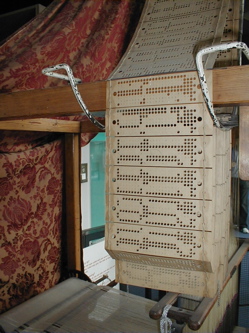
Look for a loom, a model of one or a chain of punched cards. If your gallery lacks one, use a photograph of a Jacquard loom with its hanging cards.
Weaving a pattern into cloth means lifting some threads and leaving others down, row after row. Skilled workers once did this by hand, and complex designs took days. Joseph Marie Jacquard, a French inventor, patented a loom in 1804 that read the pattern from a chain of stiff cards with holes punched in them. Where a hole lined up with a needle, the needle passed through and lifted a thread. Where there was no hole, the thread stayed down.
This was a turning point. The pattern lived on the cards, apart from the machine. Change the cards and the same loom wove a different design. Today we would say that the cards were the program and the loom was the hardware. Weavers could also keep the cards, copy them and sell them.
Stop 2: Babbage's Difference Engine (designed 1820s and 1840s)
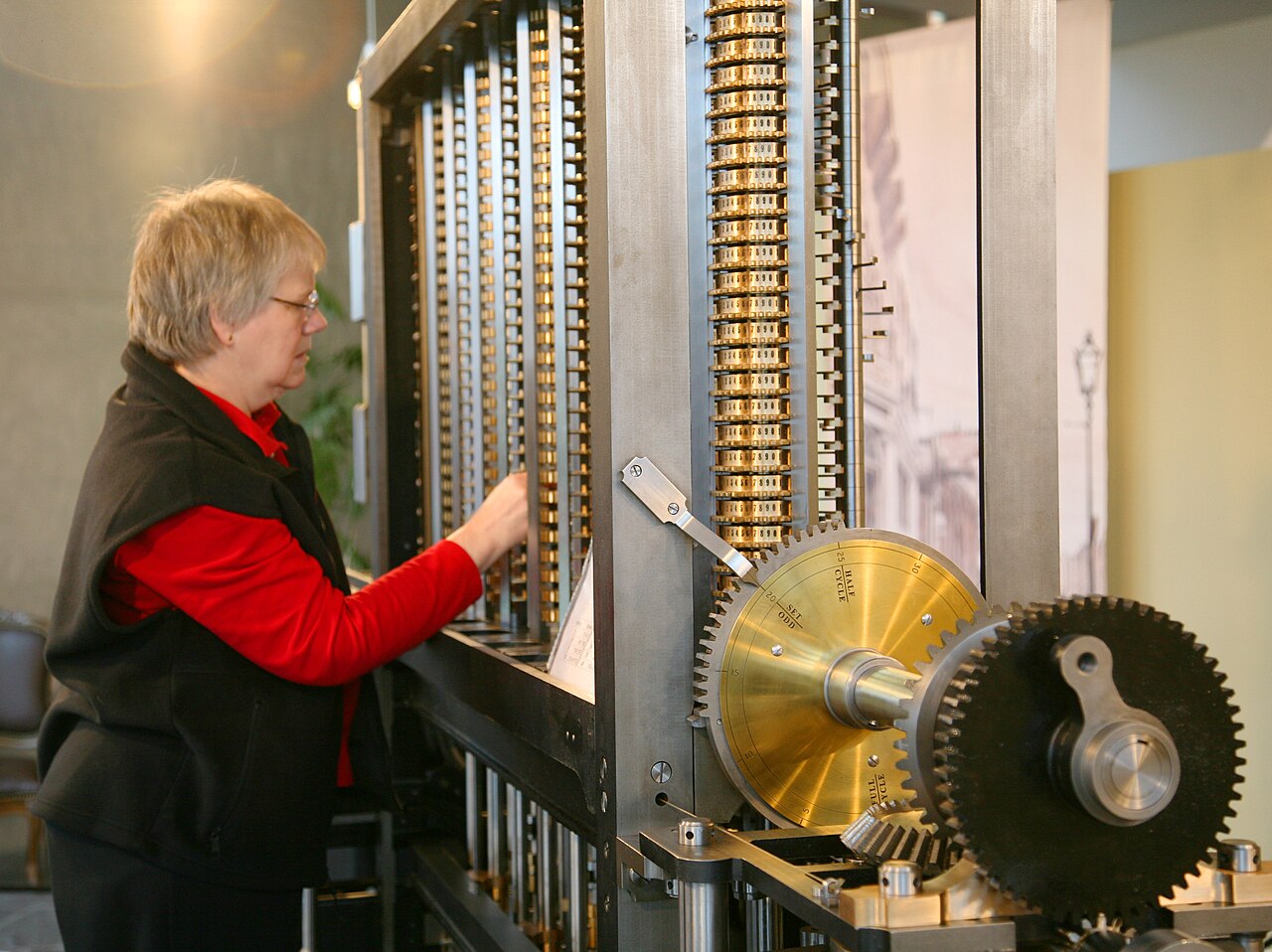
Find a Difference Engine or a model of one. The Science Museum in London built a full-size engine in 1991, and some museums display photographs or replicas.
Charles Babbage was an English mathematician who disliked mistakes. In his day, navigators, engineers and insurers depended on printed tables of numbers, and the people who prepared the tables, called computers, made errors. Babbage wanted a machine that would calculate the tables and print them, so that nothing was copied by hand.
He began his first Difference Engine in 1822. The machine used a method of differences, which allows many useful functions to be calculated using nothing but addition. He never completed the first engine, partly because of disputes over money and the difficulty of making precise parts. Later he drew up a simpler design, Difference Engine No. 2, in the late 1840s.
The Science Museum built the calculating part of Engine No. 2 in 1991, working from Babbage's drawings, and it produced correct answers. The result showed that the design was sound.
Stop 3: The Analytical Engine and Ada Lovelace (designed from 1837)
Use a drawing or a model of the Analytical Engine, together with a copy of Lovelace's 1843 notes.
The Difference Engine did one job. Babbage's next idea was far bigger. His Analytical Engine would be a general-purpose machine. It had a "mill", which did the arithmetic, and a "store", which held the numbers. Instructions would come on punched cards, borrowed from the Jacquard loom. A machine with a store, a mill and a program on cards has the same plan as a modern computer. Babbage never built it, and only parts of it were made in his lifetime.
Ada Lovelace was the daughter of the poet Lord Byron and a talented mathematician. In 1843 she translated an article about the Analytical Engine by the Italian engineer Luigi Menabrea, and added notes of her own. Her notes were about three times as long as the article. One of them set out a method for the engine to calculate a series of numbers called Bernoulli numbers, and many people call it the first published computer program. She also wrote that the engine might work on things other than numbers, if their relationships could be expressed in the machine's terms. Her image of the machine's power was poetic.
"We may say most aptly that the Analytical Engine weaves algebraical patterns just as the Jacquard-loom weaves flowers and leaves." Ada Lovelace, 1843.
Stop 4: Hollerith's tabulating machine (1890)
Look for a tabulating machine, a census card or a photograph of the 1890 census equipment.
The idea finally paid for itself in the United States census. The count of 1880 had taken years to tabulate by hand, and officials feared that the 1890 count would take longer than ten years, because the population was growing so fast. Herman Hollerith, a young engineer who had worked at the Census Office, designed a better way.
He recorded each person's information, such as age, sex and occupation, as holes in a card. A machine read the cards by passing them over small cups of mercury and pins. Where a pin found a hole, it dipped into the mercury and completed an electric circuit, advancing a dial. Clerks sorted and counted the cards at speed. The Census Office finished its preliminary count in a matter of weeks, and the full tabulation took far less time than the earlier one.
Hollerith founded a company to sell his machines. After several mergers, it became the Computing-Tabulating-Recording Company in 1911 and was renamed International Business Machines, or IBM, in 1924.
Stop 5: The punched card in the computer age (1960s)
Look for a keypunch, a deck of cards or a card from an early computer program.
The punched card lived a long life. By the mid-twentieth century the standard IBM card had 80 columns and 12 rows, and it was the usual way to give a program and data to a computer. Programmers typed their code on a keypunch, a machine like the IBM 029, introduced in 1964, which punched one card per line. They carried a stack of cards to the computer center, handed the stack to an operator and came back hours later for the printout.
A dropped stack was a disaster, since the order of the cards mattered. Programmers drew a diagonal line across the top of the deck so that it could be put back in order.
The card slowly disappeared as keyboards, terminals and screens took over. But its traces remain. Many programs still use lines limited to 80 characters, a habit that came straight from the card.
Closing the path
Gather the group at the end and ask what ran through every stop. Each machine needed a way to store instructions outside the machine, so that the same hardware could do different jobs. The medium changed from cards to tapes to chips, but the idea stayed the same. Ask the group to name the place where the instructions live in a device they carry, and to explain how it differs from a card.
Further Reading and Sources
- Swade, Doron. The Difference Engine: Charles Babbage and the Quest to Build the First Computer. Viking, 2001.
- Essinger, James. Jacquard's Web: How a Hand-Loom Led to the Birth of the Information Age. Oxford University Press, 2004.
- Lovelace, Ada Augusta. Notes on L. F. Menabrea, "Sketch of the Analytical Engine Invented by Charles Babbage." Scientific Memoirs 3 (1843).
- Austrian, Geoffrey D. Herman Hollerith: Forgotten Giant of Information Processing. Columbia University Press, 1982.