A Discussion Guide for the NeXT Web Server
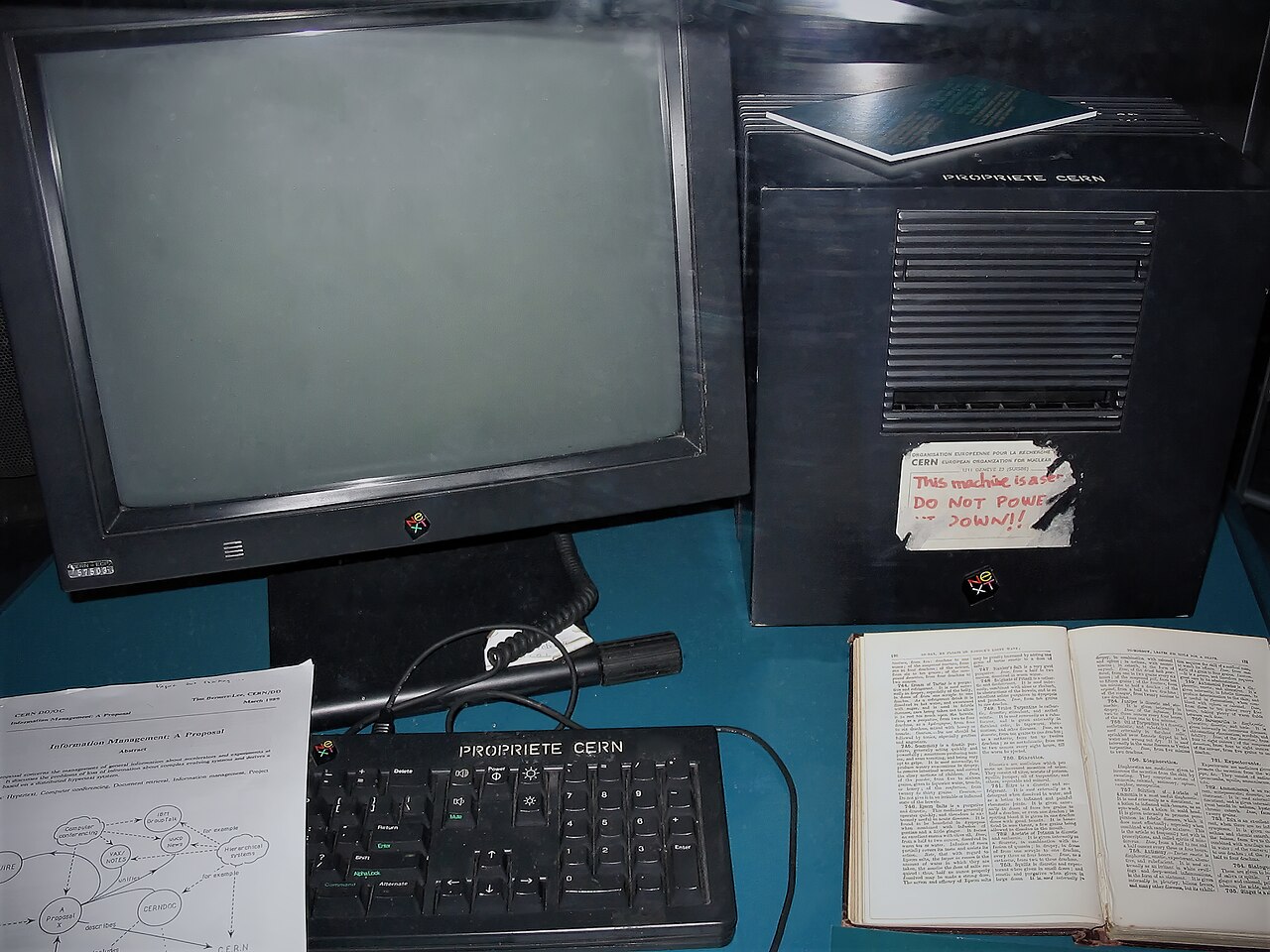
In late 1990 the World Wide Web ran on a single black computer on a desk in Switzerland. The machine was a NeXT workstation, built by the company Steve Jobs founded after he left Apple. Its owner was Tim Berners-Lee, a British software engineer at CERN, the European particle physics laboratory. This guide uses the machine to start conversations about how the Web began, what it is made of and why its design mattered.
Background for the leader
In March 1989 Berners-Lee wrote a proposal for a way to manage information at CERN. Thousands of physicists worked there, they came from many countries, and they used different computers and programs. Documents and notes were hard to find. Berners-Lee suggested a system of linked pages, which anyone could read from any computer. His supervisor, Mike Sendall, wrote on the proposal that it was "vague but exciting," and let him continue.
In 1990, Berners-Lee began to build the system on a NeXT computer, a workstation known for its advanced software. He wrote three pieces that still form the basis of the Web. The first was HTML, a simple language for writing pages. The second was HTTP, a set of rules that lets a browser ask a server for a page. The third was the URL, a way to give every page an address. He also wrote the first browser, which he called WorldWideWeb, and the first server software. The browser could display pages and also edit them. By December 1990 the system worked on his machine.
The first website described the project itself. The server, at the address info.cern.ch, was opened to outside users in 1991. Berners-Lee had taped a note to the machine's case, in his own handwriting, that read roughly: "This machine is a server. DO NOT POWER IT DOWN!!" He wanted to keep the only copy of the Web online.
In 1993 CERN announced that the Web technology was free for anyone to use, with no fees. That decision allowed it to spread quickly.
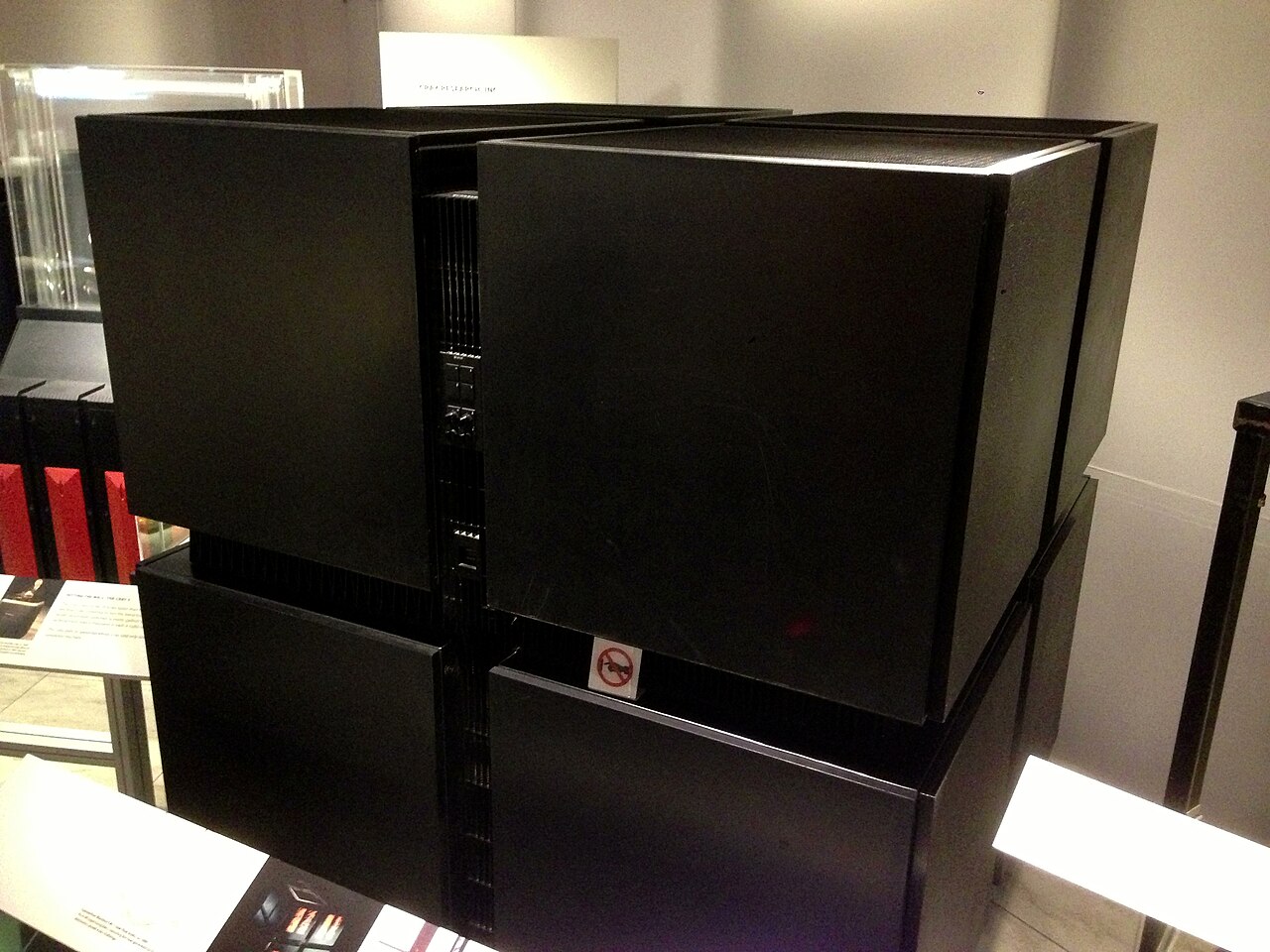
A note on the model: Berners-Lee's machine was an early NeXT computer, in the black cubic case, and people often call the whole family NeXT cubes. A later model called the NeXTcube appeared in 1990. Leaders who want to be exact can say "a NeXT computer" and leave it there.
Before the visit or lesson
Use these questions to find out what students already think and to make them curious about the object.
- Where is the Internet? When you open a website, where does the information live? Is it in the air, in a cloud, or on a physical object?
- One machine. If the whole Web ran on a single computer in your classroom and someone unplugged it, what would happen? What would you do?
- What is a server? You may have heard the word in gaming or technology. What does a server do? How is it different from your phone?
- Choosing a tool. Berners-Lee picked a powerful, well-designed workstation to build something new. Why does a good tool matter when you invent something?
While looking at the machine
- Find the handwritten note, or look at the photograph. What does it ask, and why would it be needed?
- Notice the size of the machine. Does it look like the center of something global?
- Look for buttons, ports and cables. Which ones would you use to connect it to a network?
- Ask: if you had to describe this object to someone in fifty years, which three facts would you give?
After the visit or lesson
- Physical information. Did the Web seem more real after seeing the machine? Why do we forget that the Internet depends on equipment, power and people?
- The power of a note. A hand-lettered label has become one of the best known objects in the history of technology. What does it tell us about the people who built the early Web? Was it a large company project or the work of a few?
- One place or many. The Web started on one machine and now runs on millions. What are the benefits of spreading information out? What are the risks?
- Free to use. CERN made the technology free in 1993. How might the Web be different if the inventors had charged a fee?
- Your own invention. Berners-Lee wanted to help scientists share what they knew. What problem among your friends or in your town could a simple shared system solve?
Common misconceptions to address
- "The Web is the Internet." The Internet is the global network of connected computers, and it existed before the Web. The Web is a service that runs on it, made of linked pages. Email and online games also use the Internet without using the Web.
- "One person invented everything." Berners-Lee designed the Web, and he credits colleagues such as Robert Cailliau, who helped to promote and build it. Earlier ideas about hypertext and networking came from many other researchers, and the Web depended on them.
- "It was a commercial product from the start." It began as a tool for scientists to share information. Companies came later.
Suggested timing
- 5 minutes: Ask the "Where is the Internet?" question and take three answers without comment.
- 10 minutes: Give the background from this guide in your own words, and show the photograph or machine.
- 15 minutes: Split into small groups. Give each group one post-visit question, and ask for a one-minute report.
- 10 minutes: Run the extension activity, drawing the path from keyboard to server, and compare drawings.
For younger groups, use only two of the questions and spend more time on the drawing. For older groups, add the question of who should decide whether a new technology is free, and let the debate run.
Vocabulary to introduce
- Server: A computer that stores pages or files and sends them to other computers on request.
- Browser: A program that asks for pages and shows them to the user.
- HTML: HyperText Markup Language, the code used to write a web page.
- HTTP: The rules that browsers and servers follow when they exchange pages.
- Hyperlink: A connection from one page to another that the reader can follow with a click.
Extension activity
Ask students to draw a map of what happens when they type an address into a browser. Start from the keyboard and end with the page on the screen. Label the browser, the network and the server. Compare maps and find where they differ. Many students leave out the server, and that is a good moment to return to the machine on the desk.
"The Web is more a social creation than a technical one. I designed it for a social effect, to help people work together, and not as a technical toy." Tim Berners-Lee, Weaving the Web.
References and Further Reading
- Berners-Lee, Tim, with Mark Fischetti. Weaving the Web: The Original Design and Ultimate Destiny of the World Wide Web. HarperSanFrancisco, 1999.
- CERN. "The Birth of the Web." Available at home.cern.
- Berners-Lee, Tim. "Information Management: A Proposal." CERN, March 1989.
- Gillies, James, and Robert Cailliau. How the Web Was Born. Oxford University Press, 2000.